
When J.P. Morgan reviewed internal activity, they discovered a startling reality: tens of thousands of employees were using personal AI accounts to optimize their work—long before the bank had officially rolled out a corporate strategy. This wasn’t a pilot program; it was “Shadow AI” at scale.
Most leaders think they are introducing AI to their organization. They aren’t. They are merely catching up to it.
Every week, another headline declares that AI will replace SaaS, wipe out software vendors, or make enterprise applications obsolete.
It’s an attractive story.
It’s also incomplete.
I don’t think AI is killing software.
I think it’s doing something far more uncomfortable:
AI is repricing the economics of the entire software industry.
That distinction matters because industries rarely disappear overnight. They evolve by shifting where value—and profit—actually resides.
Today, we’re watching that happen in real time.
The first illusion: AI will replace software
The early “SaaSpocalypse” narrative was simple.
If AI can answer questions, complete tasks, and generate code, why would we still need traditional software?
Just talk to an agent. Problem solved.
It’s a compelling keynote slide.
It’s much less convincing when you walk into the average enterprise.
Most organizations don’t run on elegant workflows.
They run on decades of accumulated decisions:
- ERP customisations nobody fully understands.
- CRM fields created by employees who left years ago.
- Hundreds of integrations.
- Multiple versions of the same customer.
- Approval processes designed for businesses that no longer exist.
- And, inevitably, a spreadsheet that nobody dares delete because “Michel built it in 2014.”
AI doesn’t magically remove that complexity.
It collides with it.
Recent enterprise benchmarks illustrate the point. In complex workflows spanning dozens of applications, today’s strongest AI agents still struggle to complete end-to-end tasks reliably. Most failures occur before the agent even reaches the business logic—during configuration, integration, and debugging across heterogeneous systems.
The lesson isn’t that AI lacks intelligence.
It’s that enterprise complexity remains the ultimate stress test.
The second illusion: productivity automatically creates value
The evidence is now broader than productivity alone.
TCS reported $2.6 billion in annualized AI-related revenue, yet its workforce is smaller than a year ago, reflecting AI-driven price pressure across technology services.
That sounds contradictory.
It isn’t.
AI can simultaneously increase demand and reduce the price customers are willing to pay for the effort required to deliver it.
Clients still value expertise.
They’re simply becoming less enthusiastic about funding armies of consultants to produce what AI can increasingly accelerate.
For firms whose business model depends on selling time, people, or implementation effort, AI introduces an uncomfortable equation:
- More demand does not necessarily mean more revenue per employee.
- That is not a technology problem.
- It’s an operating-model problem.
Then the AI natives arrive…
While incumbents rethink utilisation rates and pricing models, AI-native companies are setting entirely different expectations.
Whether every reported figure withstands long-term scrutiny is almost beside the point.
The direction is unmistakable.
- Revenue per employee.
- Speed of execution.
- Organisational density.
Those are becoming strategic metrics.
The question for every executive team is no longer:
“How do we use AI?”
It is:
“Which parts of our organisation exist because coordination used to be expensive?”
AI is making:
- writing cheaper.
- Coding cheaper.
- Analysis cheaper.
- Coordination cheaper.
- Increasingly, even decision support is becoming cheaper.
That doesn’t eliminate organisations.
It changes which parts of organisations continue to create value.
The Great Repricing
This is where I think the conversation needs to change.
Public markets are already applying this logic. Microsoft and Amazon have been rewarded when massive AI investment translated into visible cloud demand, while investors have become far less forgiving when spending outruns evidence of economic return.
Software companies are no longer competing primarily on feature lists.
They’re being repriced along two dimensions: operating leverage and workflow ownership.

This creates a stark divide: point solutions with weak ownership are highly vulnerable to AI commoditization, while ‘Future Category Leaders’—those who control deep, critical business processes—are best positioned to widen their moats. This is where the real value—and the highest leverage—resides.
The Headless vs. Headed Dichotomy
In this landscape, we must distinguish between “Headed” and “Headless” architecture. Traditional “Headed” software relies on a UI manually navigated by a human. In contrast, “Headless” software operates as an API or agent layer designed for programmatic interaction. Any software whose primary value is tied to its UI is at risk of being bypassed by autonomous agents that don’t need buttons to get the job done.
The unit of value is changing too
For two decades, SaaS had an extraordinarily convenient unit of value: the seat.
AI destabilises it.
If one employee can supervise several agents, should the customer pay for the human seat, agent usage, tokens consumed, workflows completed—or outcomes achieved?
The problem is that the unit that drives vendor cost, the unit customers naturally budget, and the unit that best reflects customer value are often three different things.
The next SaaS pricing battle will therefore be less about seat versus token than about finding an economic unit that preserves both customer value and vendor operating leverage.
AI is compressing both axes simultaneously.
- Companies with weak operating leverage become expensive.
- Companies with shallow workflow ownership become replaceable.
The winners will combine both.
The Three Models of AI-Era Revenue
- The Bundle (The Microsoft Model): Bolting AI (Copilot) onto existing SKUs to preserve seats while adding value.
- The Outcome (The Salesforce/Palantir Model): Charging per resolution (e.g., Salesforce’s $2-per-resolution model). This decouples value from headcount.
- The Consumption (The Frontier Lab Model): Pure API/token-based pricing.
So who survives?
Here’s the interesting part.
The companies that appear safest aren’t necessarily those with the flashiest AI demos.
They’re the ones that own business systems.
That’s why I believe the market is becoming more nuanced about companies such as SAP, Salesforce, Oracle, and other deeply embedded enterprise platforms.
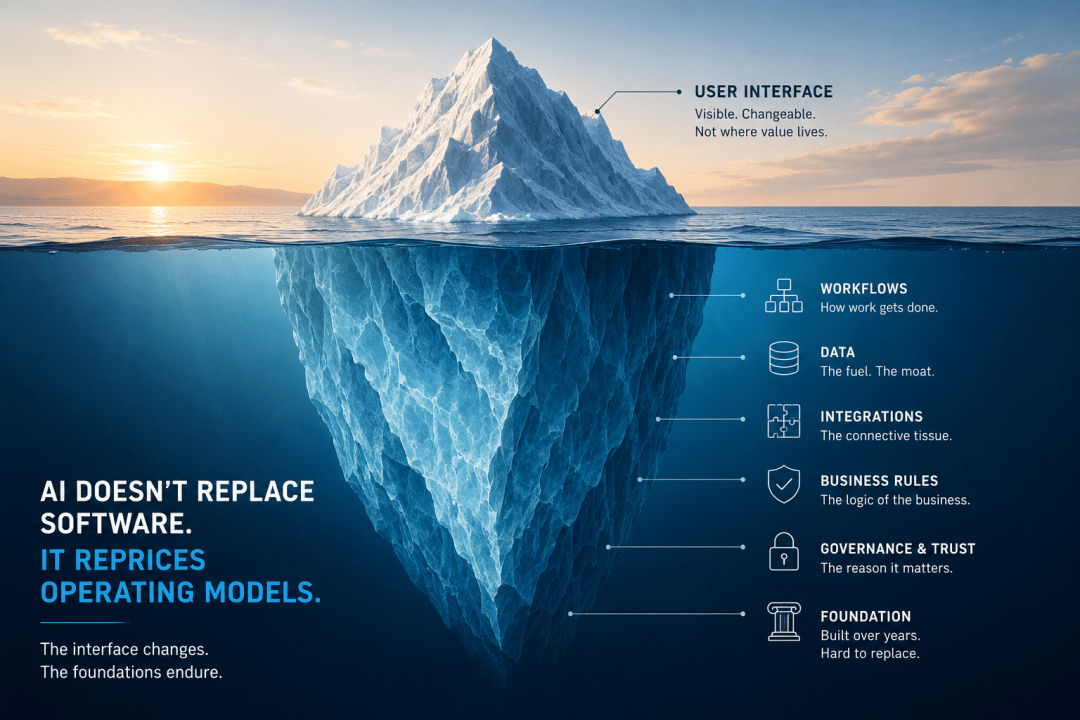
Their competitive advantage has never been the interface.
Let’s be honest—few people wake up admiring an ERP screen.
Their advantage is everything beneath it:
- trusted operational data;
- embedded workflows;
- permissions;
- compliance;
- integrations;
- business rules accumulated over years.
That’s incredibly difficult to replace.
The interface may become conversational.
The operating system of the business remains.
Increasingly, that operating system also determines who—or what—is allowed to act.
Meanwhile, many point solutions face a more uncomfortable future.
If your primary value proposition is a pleasant interface wrapped around functionality that an AI agent can increasingly replicate, you should probably be worried.
The question every software executive should ask is brutally simple:
If our interface disappeared tomorrow, what would still make customers need us?
If the answer isn’t obvious, AI probably isn’t your biggest problem.
AI doesn’t bypass the operating model. It exposes it.
This is the lesson I keep seeing across industries.
Recent results from Capgemini illustrate the point. As corporate AI adoption accelerates, clients are spending more—not less—on organising internal data, modernising legacy applications, and redesigning workflows. AI is not making the operating model disappear. It is forcing companies to repair it.
Companies often believe AI will compensate for fragmented data, unclear ownership, brittle integrations, and inconsistent processes.
It won’t.
It will expose them faster.
AI scales what already exists.
Good systems become more productive.
Poor systems become more chaotic.
That’s why I increasingly believe the winners won’t be determined by who adopts AI first.
They’ll be determined by who redesigns their operating model first.
Four questions every CEO should ask
Instead of asking, “What’s our AI strategy?”, I’d start here:

- Operating leverage
How much additional output can we create without proportional increases in cost? - Workflow & context ownership
Do we own a consequential business process and the context required to execute it? - Economic architecture
What unit creates our cost, what unit creates customer value, and what should we charge for? - Complexity & trust absorption
Can our system make enterprise complexity usable by humans and AI agents while preserving authority, governance, and trust?
Those questions will matter far longer than choosing this month’s favourite foundation model.
Recently, I was discussing these metrics with a former Microsoft executive who spent years navigating enterprise transformations. They framed these factors as a “Revenue Architecture Diagnostic”—a simple yet powerful way to stress-test your business model. Here is how I’ve adapted that framework to separate enduring value from temporary AI hype.
Revenue Architecture Diagnostic
- The Data Gravity Test: Does the customer’s data stay with them if the vendor vanishes?
- The Regulatory Core: Is the software essential for SOX, HIPAA, or SEC compliance?
- The API vs. UI Test: Can an API call replace the UI?
- NRR Drivers: Is growth driven by seats (bad) or consumption/workflow depth (good)?
- Ecosystem Health: Are third-party developers building integrations into the core?
Final thought
Twenty years ago, Marc Andreessen famously wrote that software is eating the world.
Today, AI is beginning to eat software.
But it won’t digest everything equally.
Companies that merely sell interfaces will struggle.
Companies that own workflows will endure.
Companies that redesign their operating models will define the next generation of enterprise software.
The question is no longer:
“Do you have AI?”
The question is:
“What becomes more valuable because AI exists?”
That’s where the next decade of winners will emerge.


