
Key takeaways
- AI does not fix weak GTM. It amplifies what is already there.
- B2B buyers are becoming more autonomous, invisible and AI-assisted.
- GEO is not just the next SEO; it is about being understood, cited and trusted by AI systems.
- More AI-generated content does not create more trust. Proof and relevance matter more.
- CMOs must shift from activity metrics to business outcomes, GTM clarity and proof of value.
Why AI exposes weak go-to-market faster than it fixes it
For the last 18 months, many leadership teams have been asking the same question:
How can we use AI to go faster and cheaper?
It is a logical question.
It is also the wrong first question.
Because speed is not strategy.
Volume is not relevance.
Automation is not trust.
And a pilot is not a business outcome.
AI does not fix a weak go-to-market engine.
It exposes it.
Weak positioning becomes weak positioning at scale.
Generic content becomes generic content at scale.
Misaligned teams become misaligned teams at speed.
Poor data becomes poor decisions, faster.
No proof becomes no trust.
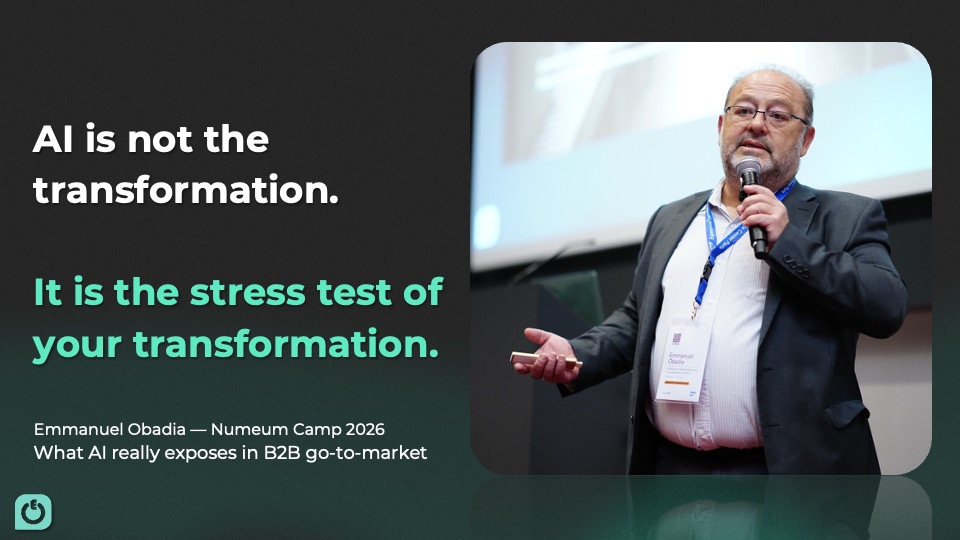
This is why AI should not be treated as the transformation itself.
AI is the stress test of your transformation.
It shows, very quickly, whether your organization is clear about whom it serves, what problem it owns, what value it creates, and what proof buyers can trust.
This was the core idea I shared in my opening keynote at Numeum Camp 2026 in Paris. But what made the morning powerful was not the keynote. It was the way several leaders then made the idea tangible through field examples from Contentsquare, Cegid, and Red Hat.
Their experiences pointed to the same conclusion:
AI does not create GTM clarity.
It reveals whether clarity exists.
What is a GTM stress test in the AI era?
A GTM stress test is the way artificial intelligence reveals whether a company’s go-to-market strategy is clear, aligned and credible. AI does not fix weak positioning, poor data, generic content or sales-marketing misalignment. It amplifies them. In B2B, AI stress-tests seven areas: ICP focus, buyer journey clarity, value proposition, messaging credibility, proof of value, sales-marketing alignment and trust.
The real question is not “what can AI do?”
AI can already do a lot.
It can summarize calls, draft content, generate sales emails, score accounts, enrich CRM records, surface intent signals, personalize campaigns, accelerate research, produce competitive scans, and assist customer success teams.
But asking what AI can do is a technology question.
The harder question is a leadership question:
Which GTM decisions should AI inform, accelerate or enrich — but never take alone?
Those decisions include:
- which segment deserves focus;
- which buyer problem is worth solving;
- which value proposition should be strengthened;
- which message is credible enough to repeat;
- which buyer journey should be redesigned;
- which workflow should be automated;
- which role should remain human;
- which initiative should be stopped.
This is where the conversation changes.
AI is not only a productivity lever.
It is becoming a mirror held up to the quality of your choices.
The buyer has changed faster than most organizations
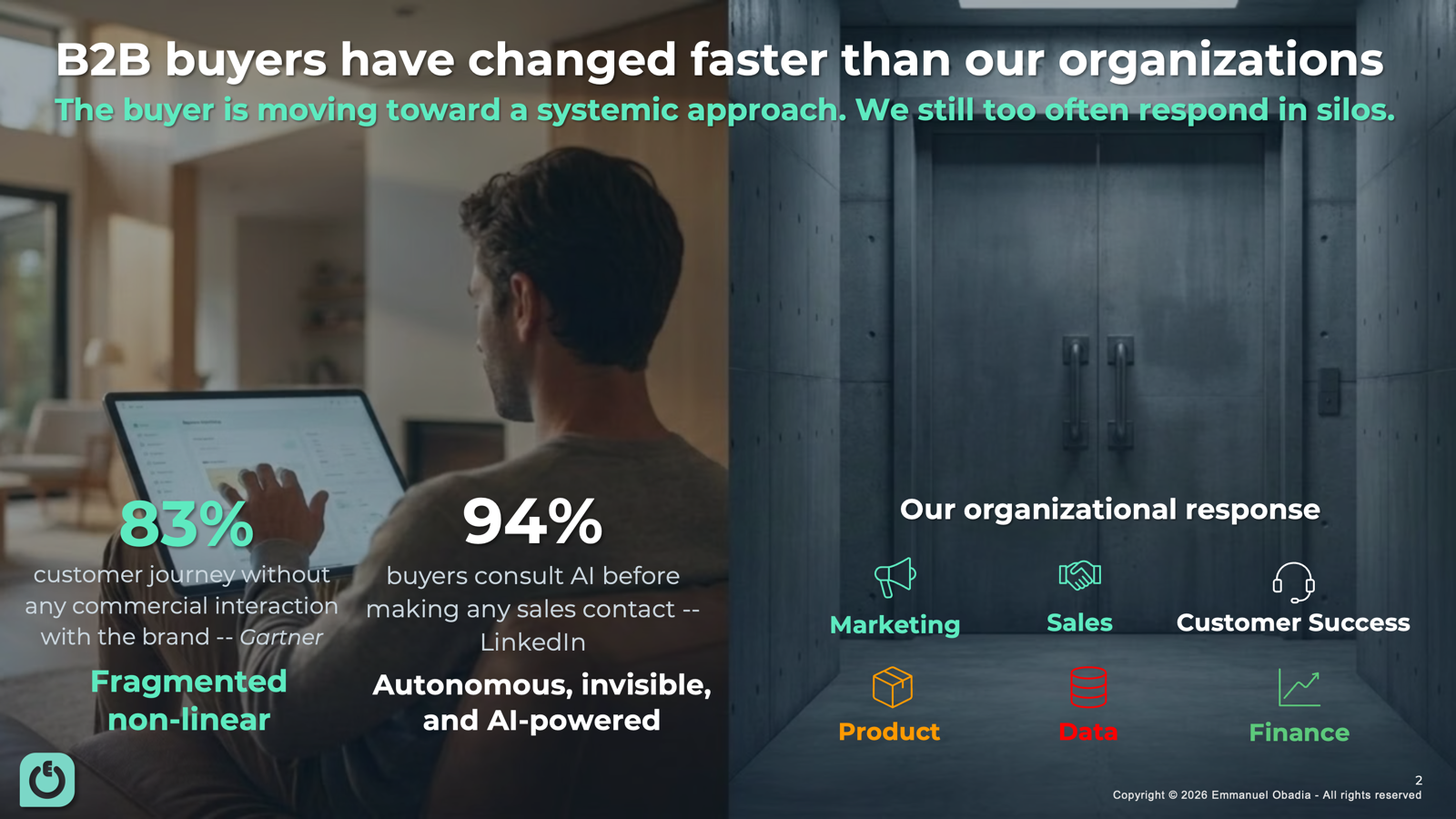
B2B buyers no longer move through the neat journey many companies designed for them.
They search differently.
They compare differently.
They validate differently.
They consult peers, communities, analysts, creators, review platforms, search engines and increasingly AI assistants before they ever talk to sales.
In many categories, the buyer journey is becoming more autonomous, more invisible and more AI-assisted.
That creates a difficult reality for marketing and sales teams.
The most important part of the buying journey may not be in your CRM.
The most influential moment may happen before a form is filled.
The buyer may have already formed an opinion before your sales team enters the conversation.
This is the dark funnel problem.
And AI is making it darker.
Not because buyers have disappeared, but because their discovery process is now distributed across more invisible touchpoints: AI search, LLM answers, private communities, peer recommendations, expert content, analyst references, and internal buying group conversations.
The question for B2B leaders is no longer only:
How do we generate more leads?
It is:
How do we stay visible, credible and useful while the buyer is forming judgment without us?
This article draws on insights shared at Numeum Camp 2026 by Jean-Christophe Pitié, Chief Marketing & Partner Officer at Contentsquare, Cédric Nattagh, VP Digital Marketing at Cegid, and Claire Delalande, VP EMEA Marketing at Red Hat, in a session focused on AI, B2B go-to-market, buyer journeys, GEO, trust and measurable business outcomes.
Field note — Cegid: when the prompt replaces the click

Cédric Nattagh, VP Digital Marketing at Cegid, shared one of the clearest examples of this shift. Cegid’s example shows that AI search can reduce visible organic traffic while improving buyer intent capture when the experience is redesigned around conversational discovery.
After Google AI Overviews were deployed in Spain in March 2025, nothing happened immediately. For several weeks, organic search traffic remained stable. Then usage changed.
Buyers started getting answers directly at the top of the page.
Over four months, Cegid observed a 22% decline in organic search sessions on its Spanish site. France, where AI Overviews had not yet been deployed, acted as a control market and remained stable.
Cédric’s diagnosis was sharp: “The prompt replaces the click.”
That line captures one of the most important GTM shifts of the AI era. The buyer does not disappear. The buyer becomes harder to observe.
Cegid’s response was not simply to chase more traffic. They redesigned part of the homepage experience around a GenAI chatbot: “Ask Anything.” The result was counterintuitive but powerful: fewer page views, but more conversions. In their test, page views declined by 7%, while lead capture increased by 18%.
Less navigation did not mean less value.
It meant the experience had become more aligned with the buyer’s intent.That is a major lesson for every B2B marketing leader: the goal is not always to preserve the old funnel. Sometimes the goal is to redesign the experience around the new buyer behavior.
GEO is not a marketing fad. It is a trust challenge.
Generative Engine Optimization, or GEO, is often presented as the next SEO.
That framing is too narrow.
GEO is not just about being found.
It is about being understood, cited and recommended by AI-mediated discovery systems.
Traditional SEO aimed to win rankings.
GEO aims to win retrieval, credibility and citation in environments where buyers increasingly ask AI systems to compare vendors, summarize options, explain trade-offs, and identify credible experts.
That changes the marketing equation.
Your brand is no longer competing only for clicks.
It is competing for interpretation.
If your positioning is vague, AI systems will struggle to summarize you.
If your proof is weak, AI systems may not trust you.
If your message is inconsistent across channels, AI systems may flatten it into generic language.
If your expertise is not visible, structured and repeated, you may be absent from the buyer’s AI-assisted shortlist.
This is why content volume is not enough.
AI has made content cheaper to produce. It has not made content more credible.
Field note — Contentsquare: from keywords to prompts

Jean-Christophe Pitié, Chief Marketing & Partner Officer at Contentsquare, framed the challenge as a dual mandate: “Perform and transform.” Contentsquare’s example shows why B2B marketers must move from keyword tracking to prompt tracking: the strategic question is no longer only whether a page ranks, but whether the brand is cited, understood and compared correctly by AI systems.
In other words: keep delivering business today while rebuilding marketing for an AI-native world.
That distinction matters.
Too many companies treat AI as an additional tool. A chatbot here. A content assistant there. A few demos. A few pilots. A few productivity hacks.
Contentsquare’s approach, as shared at Numeum Camp, was different. The team structured its work around several strategic pillars:
1. becoming discoverable, understandable and credible in AI search;
2. rebuilding digital journeys around conversation, not only navigation;
3. measuring human and bot experiences;
4. augmenting marketing teams with AI.
Jean-Christophe’s warning was clear: “A collection of demos is not a transformation.”
That sentence should be written above many AI steering committee rooms.
Because without a framework, AI becomes a theatre of isolated experiments.
In AI search, Contentsquare also highlighted a critical measurement shift: the metric is no longer only the keyword. It is the prompt.
The new questions are:
- Are we mentioned?
- Are we cited?
- Are we correctly described?
- Are we compared in the right context?
- Which competitors appear beside us?
- Where are we absent?
- Where are we misunderstood?
This is one of the biggest changes in B2B visibility.
You are no longer only optimizing pages.
You are shaping how machines understand your market position.
The content trap: more output, less trust
The first instinct of many teams has been to use AI to produce more.
More posts.
More emails.
More landing pages.
More variations.
More personalization.
More nurture sequences.
More sales enablement material.
Some of this is useful.
But there is a trap.
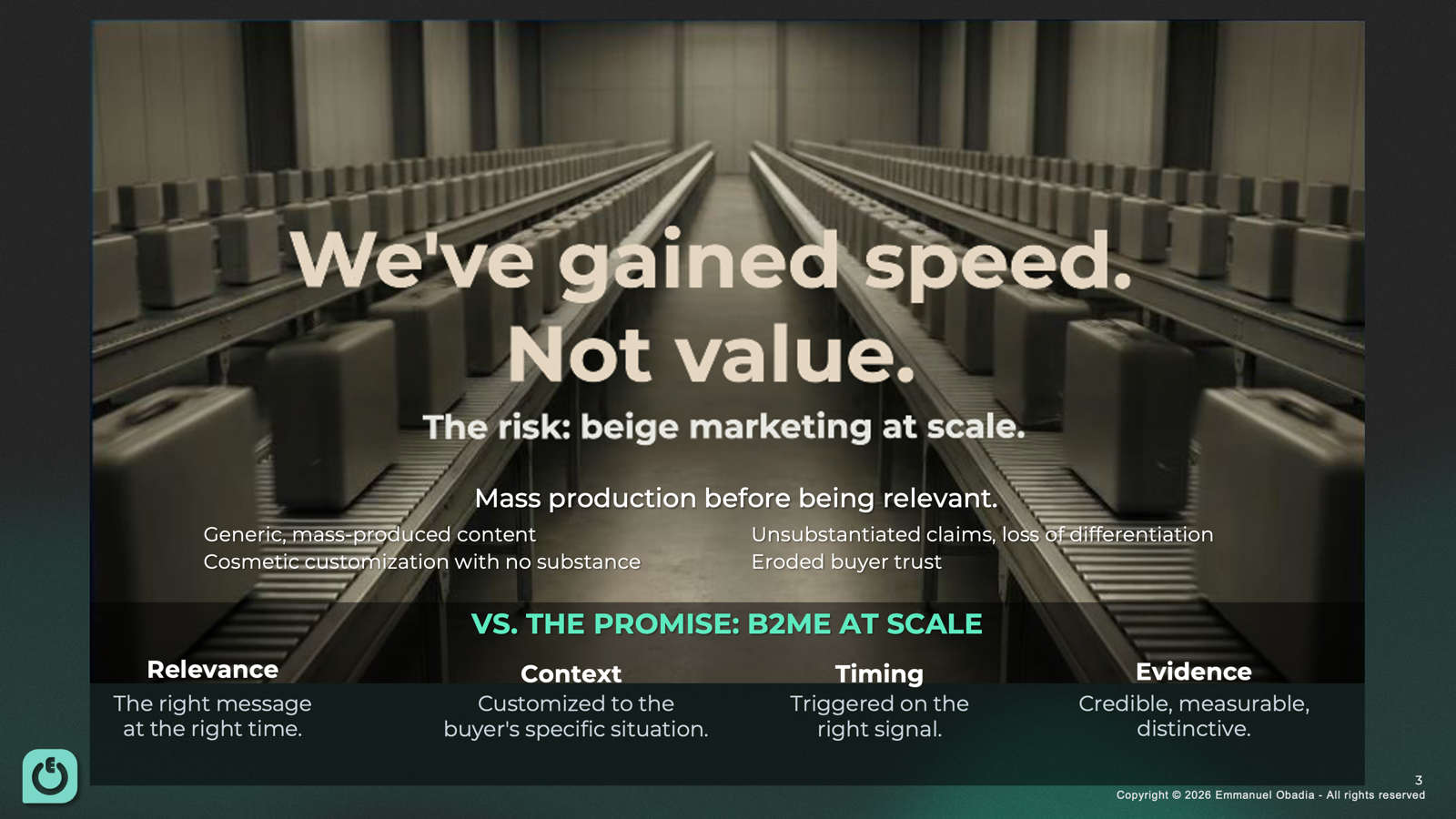
When everyone can produce more, more becomes less valuable.
The competitive advantage shifts from production to judgment.
Not: can we create more content?
But: can we create content that is more relevant, more contextual, more differentiated and more trusted?
The danger is not that AI will replace marketers.
The danger is that marketers will use AI to flood buyers with slightly better-looking noise.
Generic content at scale does not create demand.
It erodes trust at scale.
B2B buyers do not need more claims. They need proof.
They need evidence that a vendor understands their context, their constraints, their internal politics, their risks, and the progress they are trying to make.
In other words, the new promise is not personalization at scale.
It is relevance at scale.
That requires four ingredients:
- Relevance — the right message, not just another message.
- Context — adapted to the buyer’s real situation.
- Timing — triggered by a meaningful signal, not by marketing automation logic alone.
- Proof — credible, measurable and distinctive evidence.
AI can help deliver these.
But it cannot invent them if the organization has not done the strategic work.
Boards do not want AI pilots anymore
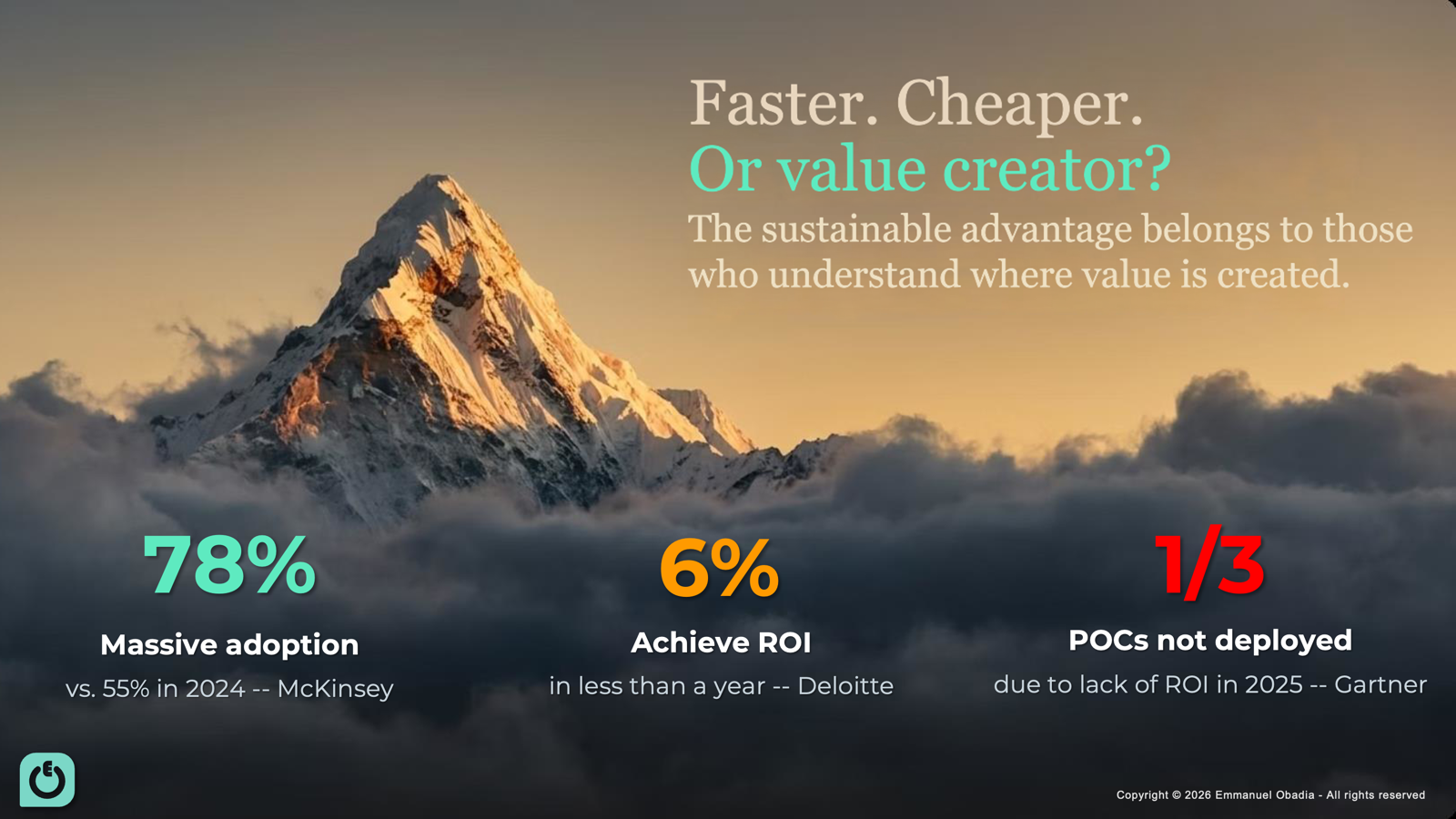
The early phase of AI adoption was dominated by exploration.
Experimentation was useful.
But the patience for endless pilots is shrinking.
Boards and executive committees are no longer impressed by the number of AI use cases.
They want outcomes.
They want to know:
- What changed in pipeline quality?
- What improved in conversion?
- What reduced customer acquisition cost (CAC)?
- What accelerated cycle time?
- What increased retention or expansion?
- What work was removed, not merely assisted?
- What decisions improved because of AI?
This is the shift from AI theatre to AI economics.
The question is not: How many pilots are running?
The question is: Which business decisions are better because of AI?
If the answer is unclear, the pilot is not a transformation.
It is an expensive distraction.
AI reveals three fragilities
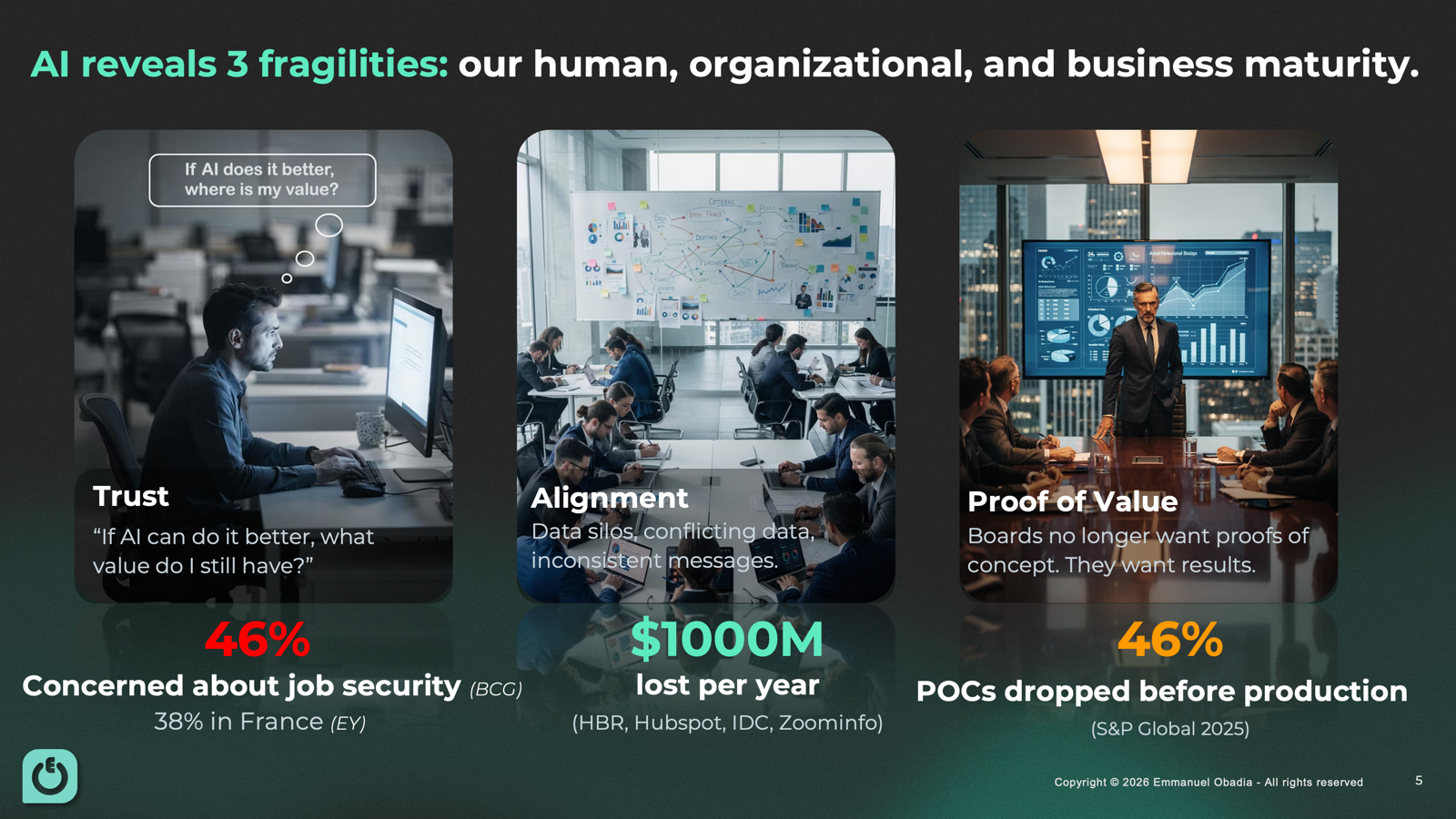
When AI enters a go-to-market organization, it tends to reveal three fragilities very quickly.
1. Trust
If AI can produce, write, research, recommend and analyze faster than people, many employees quietly ask:
What is my value now?
That question is not only psychological.
It is strategic.
If leaders do not redefine the human role clearly, teams may either resist AI, overuse it without judgment, or use it secretly through uncontrolled tools.
Trust is not only external.
It is internal.
People need to understand where AI assists, where humans decide, and where judgment remains non-negotiable.
2. Alignment
AI exposes silos because it depends on connected context.
Marketing may use one dataset.
Sales may trust another.
Customer success may hold the real adoption signals.
Finance may define value differently.
Product may interpret customer needs through roadmap constraints.
AI does not magically align these perspectives.
It can amplify the contradictions.
If teams are not aligned on ICP, value proposition, buying journey, definitions, handoffs and success metrics, AI will help each team move faster in different directions.
That is not transformation.
That is accelerated fragmentation.
3. Proof of value
AI makes weak claims easier to produce.
But it also makes unsupported claims easier to detect.
Buyers have more tools to compare, verify, summarize and challenge vendor narratives.
The burden of proof is rising.
It is no longer enough to say “we help companies transform” or “we improve productivity.”
Buyers want evidence.
What changed?
For whom?
In what context?
With what measurable impact?
Compared to what alternative?
The companies that win will not be those with the most AI-generated messaging.
They will be those with the strongest proof architecture.
Field note — Red Hat: speed without trust is not performance

Claire Delalande, VP EMEA Marketing at Red Hat, brought an essential counterweight to the productivity narrative. Red Hat’s example shows that AI-enabled speed only creates sustainable performance when it is governed by trust, approved frameworks, responsible usage and human judgment.
Her theme was not only acceleration.
It was: “Credibility, trust and responsibility.”
That matters because AI makes it easier to create, adapt and distribute assets. But the real question is whether speed remains governed by trust.
Red Hat’s example showed that AI can reduce production time, empower teams, and accelerate content adaptation. But Claire’s contribution pointed to the deeper condition for sustainable performance: approved frameworks, responsible usage, transparency, and human judgment.
Her message can be summarized simply: Trust is not a soft value. It is a performance condition.
In an AI-saturated market, credibility becomes as strategic as visibility.
You can be visible and not trusted.
You can be productive and not credible.
You can be faster and still create confusion.
This is why responsible AI is not only an ethics topic. It is a GTM topic.
The CMO is in the hot seat
This creates a new pressure on marketing leadership.
The CMO is no longer only responsible for brand, demand, content, campaigns and events.
The CMO is increasingly expected to act as a revenue architect.
That means connecting brand authority, buyer insight, content credibility, sales alignment, data quality, customer proof, AI adoption and measurable business outcomes.
This is why the CMO role is becoming harder, not easier.
AI removes some execution friction.
But it increases leadership accountability.
When content is easier to produce, the CMO must defend quality.
When buyer journeys are harder to track, the CMO must rethink measurement.
When AI search changes discovery, the CMO must protect brand visibility and credibility.
When the board asks about ROI, the CMO must connect activity to outcomes.
AI is not reducing the CMO’s strategic burden.
It is exposing it.
The seven GTM decisions AI should not make for you
AI will increasingly assist the work.
It will recommend.
Score.
Summarize.
Generate.
Predict.
Personalize.
Automate.
But leadership still owns the judgment.
There are at least seven GTM decisions AI should not make alone.
1. Who do we serve? AI can analyze segments. It cannot decide your strategic focus.
2. What problem do we own? AI can surface pain points. It cannot decide which problem your company has the right to solve.
3. What message is credible enough to repeat? AI can generate messaging options. It cannot decide which one deserves your reputation.
4. What proof do buyers trust? AI can organize evidence. It cannot create credibility where there is none.
5. What should be automated? AI can identify repetitive work. It cannot decide what should remain relational, strategic or sensitive.
6. What should remain human? AI can assist interactions. It cannot replace empathy, trust-building, moral judgment or executive courage.
7. What should we stop doing? AI can show inefficiency. But stopping initiatives requires leadership.
And this may be the most important decision of all.
Because the companies that win with AI will not be those that do everything faster.
They will be those that know what not to scale.
The real advantage is GTM clarity
AI will become more powerful.
Tools will improve.
Agents will become more autonomous.
Workflows will become more automated.
But as AI becomes more accessible, the technology itself will become less differentiating.
The real advantage will shift elsewhere.
To clarity.
To alignment.
To proof.
To trust.
To judgment.
To the ability to decide where value is really created.
That is why AI is not your GTM strategy.
It is your GTM stress test.
If your GTM is clear, AI can help scale it.
If your GTM is fragmented, AI will make the fragmentation faster, louder and more expensive.
The real question for B2B leaders is therefore not: How do we use AI to go faster?
It is: Are we accelerating something worth scaling?
That is the question every CMO, CRO, CEO and founder should be asking now.
FAQ
What does AI expose in B2B go-to-market?
AI exposes weak positioning, unclear ICPs, generic content, poor data quality, misaligned sales and marketing teams, lack of proof, and fragile customer trust.
Why is AI not a GTM strategy?
AI is not a GTM strategy because it does not decide which market to serve, which problem to own, which message is credible, or which proof buyers trust. Those remain leadership decisions.
What is GEO in B2B marketing?
GEO, or Generative Engine Optimization, is the practice of making a brand discoverable, understandable, citable and credible in AI-powered search engines and answer engines such as ChatGPT, Perplexity, Gemini and Google AI Overviews.
How is the B2B buyer journey changing with AI?
B2B buyers increasingly use AI tools, peer communities, review platforms and answer engines before speaking with sales. This makes the buyer journey more autonomous, less visible and harder to measure through traditional CRM or website analytics.
What should CMOs do differently in the AI era?
CMOs should shift from producing more content to building more trust, proof and authority. They must connect brand, buyer insight, sales alignment, data quality, GEO and measurable business outcomes.
How to use this article
Use this article as a diagnostic checklist for your next GTM leadership meeting. Ask whether your AI initiatives are improving clarity, alignment, proof and buyer trust — or simply accelerating fragmented execution.
| AI stress-tests… | What it reveals |
|---|---|
| ICP focus | Whether the company knows whom it serves |
| Buyer journey | Whether the organization understands how buyers decide |
| Messaging | Whether the value proposition is credible |
| Content | Whether output creates trust or noise |
| Data | Whether teams share a common source of truth |
| Sales-marketing alignment | Whether teams move in the same direction |
| Proof of value | Whether claims can be backed by evidence |
Want to stress-test your GTM strategy for the AI era?
Let’s identify where AI will amplify your strengths — and where it may expose weak positioning, poor alignment or missing proof.


