
TL;DR
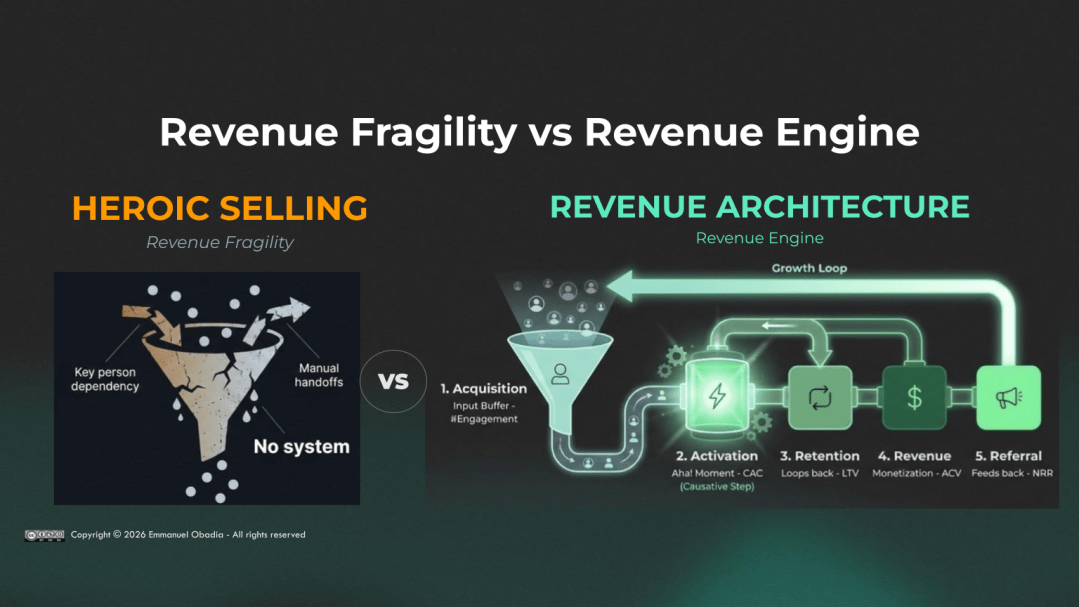
- Most companies don’t have a sales problem — they have a Revenue Fragility problem
- Revenue Fragility is when results depend on key people, not a system
- The fix is Revenue Architecture: a designed, reproducible commercial engine
- AI amplifies the system it enters — weak systems + AI = faster confusion
- At Oracle EMEA, focusing energy on prioritised accounts produced 3× more opportunities, 2× higher win rates, and 2.2× larger deal size
- The question is not “how do we sell more?” — it is “how do we build a system that compounds?”
Your pipeline may not be the problem.
Your people may not be the problem.
Even your AI stack may not be the problem.
The real issue is often invisible:
Revenue Fragility.
B2B buying has moved through four phases over 70 years — from the catalogue salesperson who controlled information, to the consultant, to today’s autonomous buyer who completes 83% of the journey without your team. Most commercial models never caught up.
Growth appears healthy. Numbers look green. Dashboards reassure everyone.
Until a few key people leave. A market shock hits. Execution slips. Forecasts wobble. AI gets deployed into confusion.
Then the truth appears.
What looked like momentum was often dependency.

What Is Revenue Fragility?
Revenue Fragility is what happens when commercial performance depends too heavily on individuals, tribal knowledge, heroic effort, or unmanaged complexity.
It often hides behind success.
Many companies mistake strong results for strong systems. They are not the same thing.
The Real Fix: Revenue Architecture
Most growth problems are design failures misdiagnosed as execution failures.
Revenue Architecture is the operating design behind scalable growth.
It answers five leadership questions:
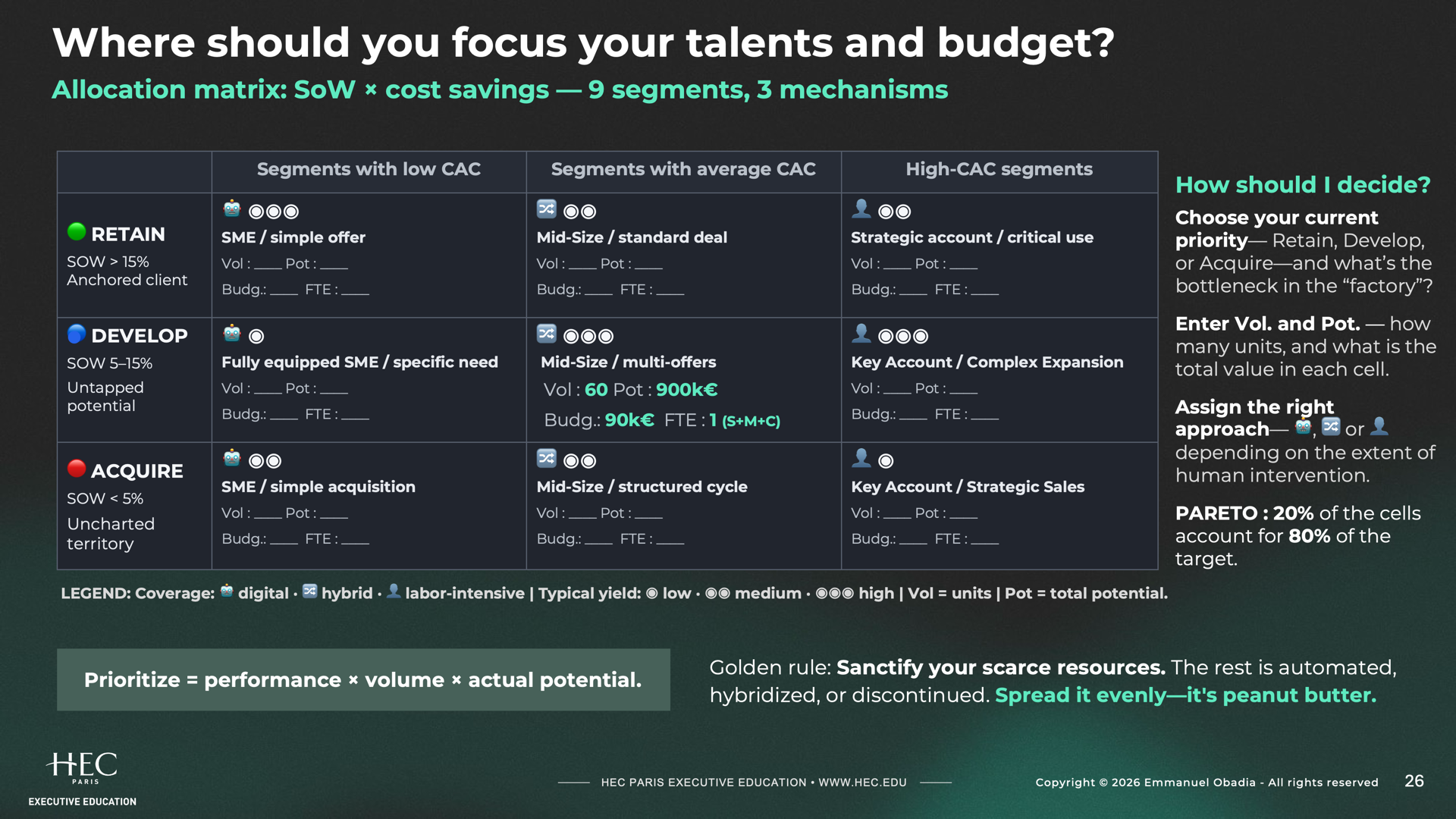
- Where should scarce commercial energy go?
- Which accounts should we retain, develop, or acquire?
- Where are handoffs breaking between marketing, sales, product and customer success?
- What do managers inspect, coach, and escalate?
- Which metrics predict progress — not just report history?
When these choices are clear, growth compounds.
When they are vague, heroics fill the gap.
Why Many AI Projects Underperform
AI is powerful.
But AI amplifies the system it enters.
Weak systems + AI = faster confusion.
If segmentation is unclear, priorities fuzzy, handoffs broken, and management rhythms inconsistent, AI rarely creates leverage. It accelerates noise.
I saw an earlier version of this dynamic at Oracle EMEA, where we combined AI, ABM, and data across 36,000 named accounts.
Over one fiscal year, my operations team analysed 11,000 opportunities, comparing high-priority accounts versus low-priority or unscored accounts.
The outcome: opportunities tripled, win rates doubled, and average deal size increased x2.2 when scarce commercial energy was focused where signals were strongest.
Today, GenAI adds another layer: a contrarian strategic sparring partner, plus hyper-personalised touchpoints and engagement at scale.
First, design the machine. Then accelerate it.
Symptoms Leaders Often Misread
- Pipeline volume rises, but forecast confidence falls.
- A few top performers carry a disproportionate share of results.
- Customer Acquisition Cost (CAC) increases while conversion rates stall.
- New tools create activity, but managers see little leverage.
- Coverage models remain equal even when customers and opportunities are not.
Five Brutally Honest Questions for Leaders
- If our top three sellers left tomorrow, what percentage of revenue would leave with them?
- Are we allocating resources strategically, or spreading too little peanut butter on too large a slice of bread?
- Do acquisition, retention, and expansion require different talent models in our business?
- Are teams aligned around customer progress — or internal silos?
- Would AI improve execution today, or expose confusion faster?
Execution rhythm matters as much as strategy: a bi-weekly Sales Sprint — where every deal is classified as Start, Nurture, or Stop based on real engagement signals — prevents the pipeline theatre that makes forecasts unreliable.
What Experience in the Field Keeps Confirming
Across roles at Oracle, Salesforce, Sun Microsystems, Sage, advisory work with leaders at Wallix and Bureau Veritas, and now with executives at HEC Paris, one lesson keeps repeating:
- Growth rarely stalls because people suddenly became less talented.
- It stalls because complexity outgrew the operating model.
- That is a Revenue Architecture issue.
The same logic played out at Nefab, which pivoted from selling wooden crates at unit price to selling total supply chain cost reduction with a measurable ROI — growing revenue 2.3× in four years on the same market, by redesigning their commercial system rather than adding headcount.
Final Thought
More effort rarely saves a broken system.
Better design often does.
Build a revenue engine. Or keep funding dependency.
If growth feels harder than it should, if too much depends on a few people, or if AI is adding motion without leverage — these are often architecture problems.
I help leadership teams rethink commercial systems at growth inflection points — from CRO and VP Marketing advisory to ABM leadership coaching and executive education.
If these tensions are surfacing in your organisation, feel free to reach out or share what you are seeing.
Frequently Asked Questions
What is Revenue Fragility?
Revenue Fragility is the structural condition in which commercial performance depends so heavily on key individuals, tribal knowledge, or heroic effort that it cannot scale, survive attrition, or withstand market shocks — regardless of how strong current results appear.
What is the difference between Revenue Fragility and a sales problem?
A sales problem is about pipeline volume, conversion rates, or individual skill gaps. Revenue Fragility is structural — it describes a system that cannot reproduce its results without the same specific people in the same specific conditions.
What is Revenue Architecture?
Revenue Architecture is the operating design behind scalable, predictable commercial growth. It covers five decisions: where to concentrate commercial energy, which accounts to retain, develop or acquire, where handoffs break between marketing, sales and customer success, what leaders inspect and coach, and which metrics predict future performance rather than report past activity.
Why do AI projects underperform in sales organisations?
AI amplifies the system it enters. In a fragile system — unclear segmentation, broken handoffs, no management rhythm — AI accelerates confusion rather than creating leverage. The architecture must be designed before it is accelerated.
What did the Oracle EMEA case prove about account prioritisation?
Analysing 11,000 B2B opportunities across 36,000 named accounts using AI-driven scoring showed that focusing commercial energy on high-priority accounts produced 3× more opportunities, 2× higher win rates, and 2.2× larger average deal size versus unscored accounts in the same territory and fiscal year.


