

In today’s cutthroat B2B sales and marketing landscape, playing it safe won’t cut it. You need to do more than sell—you need to deliver progress. Understanding your customers isn’t just a nice-to-have; it’s your competitive edge. But how do you crack the code of what truly drives your buyers? Two game-changing tools hold the answer: the Jobs-To-Be-Done (JTBD) framework and Generative AI. Together, they’re not just tools—they’re your secret weapons for staying ahead.
Stop selling products. Start solving real problems
The Power of JTBD: Beyond Selling to Progressing
Let’s get real: your customers don’t care about your product. What they care about is what it can do for them. The JTBD framework, popularized by Clayton Christensen and Bob Moesta, forces a mindset shift. Stop selling products. Start solving real problems—identify what progress your customers truly seek. With JTBD, the question isn’t what they buy, but why.
The JTBD framework is more than just theory—it’s a tool you can apply today to gain a competitive edge. Here’s how it helps you take action:
- Clarify Customer Needs: Understand what truly motivates your customers, beyond features and price points.
- Build Targeted Solutions: Design offerings that address specific customer jobs, driving better adoption and loyalty.
- Streamline Messaging: Align your marketing and sales strategies with a focus on customer progress, making your value clear and compelling.
- Identify Growth Opportunities: Uncover gaps in the market by analyzing unmet jobs and addressing them head-on
JTBD focuses on three types of “jobs” your customers are hiring you to do:
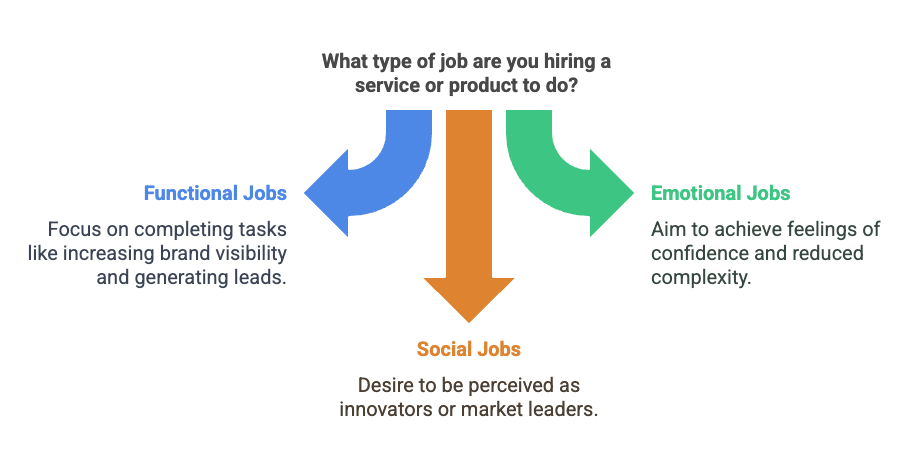
- Functional Jobs: What tasks are they trying to complete? (e.g., increasing brand visibility, generating qualified leads.)
- Emotional Jobs: How do they want to feel? (e.g., confident in their decisions, less overwhelmed by complexity.)
- Social Jobs: How do they want to be perceived? (e.g., as innovators, market leaders.)
💡 Suggested Steps:
- Identify your customers’ functional, emotional, and social jobs through thorough surveys or detailed interviews, ensuring you gather a comprehensive understanding of their needs and aspirations. Conduct interviews or surveys to uncover their functional, emotional, and social jobs. Ask, “What frustrates you most about your current solutions?” or “What does success look like to you?”
- Map out how your product currently supports each job and where it falls short, taking into account not just the direct functionalities but also the subtleties of user experience and emotional engagement. Create a visual map of how your product supports each type of job, highlighting gaps or opportunities for improvement.
- Consider the feedback provided by your customers to refine your product’s offerings, aiming to bridge any identified gaps, and enhance overall satisfaction.
This iterative process will allow you to create a more aligned and effective solution that resonates deeply with your target audience.
The Four Forces of Progress: Driving Change or Stalling Decisions

Change doesn’t happen in a vacuum. When customers decide to adopt a new solution, they are influenced by the four forces of progress, as outlined by the JTBD framework. These forces work in tandem to either push them toward change or hold them back. Understanding these dynamics is crucial:
- The Push of the Current Situation: What frustrations or inefficiencies are making customers dissatisfied with the status quo?
- The Pull of the New Solution: What benefits or outcomes are enticing them to switch?
- Anxieties of the New Solution: What fears or uncertainties might stop them from taking the leap?
- Habit of the Present: What ingrained behaviors or routines are keeping them tethered to their current way of doing things?
These forces are constantly at play, and as a B2B professional, your job is to amplify the push and pull while addressing anxieties and habits. By tackling these forces head-on, you position your solution not just as an option, but as the obvious next step in their journey.
In order to uncover them you could:
- Identify Friction Points: Use customer feedback to identify common sources of hesitation, such as fears about switching or habit inertia. Address these in your messaging.
- Run a Change Workshop: Organize a session where your team identifies how your solution amplifies the push/pull forces while mitigating anxieties and habits.
Real-World Examples: Intuit QuickBooks and Intercom
Still skeptical? Let’s break it down with two examples Bob Moesta swears by:
- Intuit QuickBooks: Intuit transformed from a simple software provider into a trusted ally for small businesses, all by understanding a profound truth: entrepreneurs seek not just accounting software, but a pathway to reclaim their time and mental clarity. QuickBooks isn’t merely about crunching numbers; it’s about delivering peace of mind and empowering business owners to focus on their dreams. By brilliantly repositioning QuickBooks as an essential tool for clarity and control, Intuit conquered both the functional and emotional aspects of entrepreneurship. This strategic pivot has propelled them to become the powerhouse of accounting software, boasting a remarkable market share exceeding 70% among small businesses.
- Intercom: Intercom started with a product that had potential but was unfocused. They discovered the key to their success was helping customers onboard users, boost engagement, and provide top-notch support. By honing in on these needs, they transformed from scattered efforts to precise impact—and their growth skyrocketed! In just 18 months, they increased their customer base by 5 times and their annual recurring revenue by 15 times. Rather than developing more features, Intercom strategically split their existing platform into four distinct products, each laser-focused on a specific Job To Be Done (JTBD) with corresponding pricing. This approach ensured they captured all opportunities in the market, avoiding leaving money on the table.
Generative AI: JTBD’s Catalyst

JTBD is powerful on its own, but Generative AI is what supercharges it. Think of Generative AI as your unfair advantage—it takes the guesswork out of understanding and serving customers. Tools like Perplexity AI turn mountains of data into crystal-clear insights, giving you the ammo you need to act decisively.
Here’s how Generative AI takes JTBD from theory to execution:

- Decode Customer Motivations: Generative AI dives into customer interactions, market trends, and competitor moves to expose what’s really driving decisions.
- Personalize Like Never Before: It doesn’t just automate personalization—it hyper-personalizes, tailoring campaigns and solutions to exact customer needs.
- Spot Bottlenecks: By identifying inefficiencies and unmet needs, Generative AI shows you where your customers are stuck—and how you can help.
- Power Your Strategy with Prompts: Use AI-driven prompts to explore challenges and uncover actionable insights. Example: “What are the biggest struggles of SaaS CMOs in 2025?”
💡 Suggestions:
Use AI tools like Perplexity to run exploratory prompts tailored to uncover key customer challenges that may not be immediately apparent. By engaging with these insights, marketers can gain a deeper understanding of customer behavior, preferences, and pain points. Start with prompts like: “What are the biggest frustrations SaaS companies face with onboarding?” or “What features do mid-sized companies find most valuable in CRM tools?”
Additionally, leverage Generative AI insights to create three hyper-personalized campaign ideas this quarter, ensuring that each idea resonates specifically with target demographics, thereby enhancing engagement and driving conversion rates. Segment customers by their specific jobs and use AI to craft tailored campaigns that directly address their needs. Such strategic use of AI in marketing can lead to more effective and responsive campaigns that adapt to ongoing trends and consumer feedback.
Example: Using Perplexity AI in Practice
During a recent session, I ran this prompt: “What are SaaS marketing leaders’ priorities for 2025?” The AI didn’t just spit out generic advice—it revealed that ROI analytics and cross-team alignment were top concerns. Armed with this intel, a SaaS company created dashboards showcasing ROI in real time, addressing both functional and emotional jobs. Game. Set. Match.
Want to try this yourself? Here are killer prompts to get you started:
- “List the top challenges for SaaS CMOs and their solutions.”
- “What KPIs matter most for mid-sized SaaS firms expanding in EMEA?”
- “What barriers prevent SaaS marketers from adopting analytics tools?”
Applying JTBD + Generative AI: A Practical Guide
1. Map Customer Progress

Be ruthless about understanding what progress looks like for your customers. Map out their functional, emotional, and social jobs:
- Functional: Running omnichannel campaigns without chaos.
- Emotional: Confidence they’re on the right track.
- Social: Recognition as innovative leaders.
💡 Suggestions:
- Conduct JTBD Interviews: Interview customers to uncover their progress goals and build actionable profiles for your teams.
- Develop a Progress Scorecard: Quantify how well your solution supports their functional, emotional, and social jobs and track improvements over time.
Take the time to understand what “progress” means to them. Without this clarity, even the best solutions will feel like a shot in the dark.
2. Analyze Tensions
Generative AI is a spotlight, revealing bottlenecks that stall customer success. For example, when analyzing feedback from SaaS marketers, Perplexity AI identified a pervasive issue: siloed data. This insight led to tailored integration strategies, uniting disparate systems and resolving pain points.
Ask yourself: What’s stopping your customers from moving forward? Use tools like AI-driven prompts to unearth their biggest challenges and design precise interventions.
💡 Suggestions:
- Use AI to Surface Challenges: Run prompts like “What prevents [your audience] from adopting new solutions?” to uncover blockers.
- Develop Targeted Messaging: Address anxieties or habits head-on in your outreach, highlighting how your solution resolves them.
3. Create Solutions, Not Products
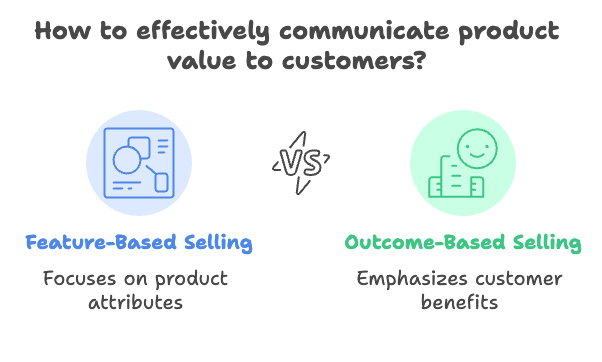
Your customers don’t care about what you’re selling; they care about how it makes their lives easier. Don’t pitch your features. Sell the outcomes.
- Instead of “cloud storage,” position it as “secure, scalable collaboration” that not only enhances teamwork but also ensures data integrity and fosters productivity across diverse teams and projects.
- Instead of simply referring to them as “analytics tools,” it is crucial to highlight their remarkable ability to deliver actionable insights in just a matter of seconds, enabling businesses to make informed decisions swiftly and effectively.
Frame your product as the superhero enabling their progress—the tool that gets them from Point A to Point Better-Than-Ever.
💡 Suggestions:
- Reframe Your Value Proposition: Rewrite product descriptions to focus on outcomes, not features. For example, “Real-time collaboration that saves teams hours weekly” instead of “Cloud storage with 2TB capacity.”
- Run a Benefits Test: Share revised messaging with a test group and measure its effectiveness compared to traditional product-based language.
4. Align Messaging
Mixed messages kill momentum. Your sales and marketing teams need to act as a single voice, consistently speaking to the customer’s JTBD. AI insights can make this happen. For instance, use a prompt like, “What are the most effective ways for SaaS companies to ensure message alignment across customer touchpoints?” Perplexity AI can generate actionable insights to align your teams, creating a unified customer journey from first touch to final sale.
💡 Suggestions:
- Collaborate Across Teams: Use insights from sales and marketing to align on a unified message that emphasizes JTBD outcomes.
- Audit Your Customer Journey: Ensure every touchpoint—from ads to post-sale support—reinforces the same progress-focused narrative.
5. Measure What Matters
Success isn’t what you claim; it’s what you can prove. Data-driven dashboards don’t just measure KPIs—they tell stories. Imagine presenting a dashboard showing your impact: reducing lead response times by 30%, improving team efficiency by 50%, or cutting operational costs by 20%.
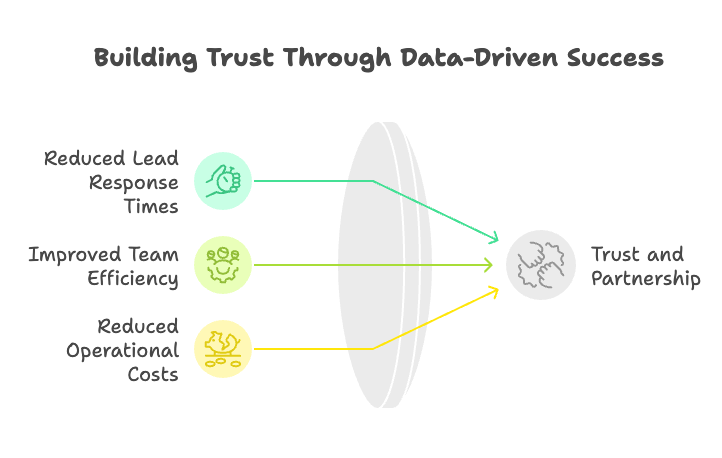
These numbers aren’t just metrics; they’re trust-builders. They validate your solution and reinforce your position as a partner in their success.
By weaving these strategies together, you’re no longer just a vendor. You become a co-creator of their progress—a partner who understands their journey and works alongside them to make it happen.
💡 Suggestions:
- Track Customer Outcomes: Set up dashboards to measure how your solution directly impacts KPIs like efficiency, satisfaction, and cost savings.
- Share Customer Stories: Showcase testimonials and case studies that quantify success, such as “Reduced response time by 50% in three months.”
From Selling to Solving: The Takeaway

Customers don’t care solely about your product—they care about their progress and how your offerings can facilitate that journey.
The B2B world is ruthless. Customers don’t care solely about your product—they care about their progress and how your offerings can facilitate that journey. By embracing the Jobs To Be Done (JTBD) framework combined with the innovative capabilities of Generative AI, you can transform your role from a mere vendor into a strategic partner who consistently delivers measurable results. This shift in perspective is not just a minor adjustment; it’s a fundamental change in how we approach business relationships. It’s time to stop merely selling products and start actively solving challenges, addressing the specific needs and aspirations of your clients in a more meaningful and impactful way. This proactive approach not only enhances customer satisfaction but also fosters loyalty and long-term partnerships that drive mutual success.
Summary: Key Takeaways and Tips
| Main Point | Summary | Actionable Tips |
|---|---|---|
| The Power of JTBD | Understand why customers “hire” your product or service. | – Identify functional, emotional, and social jobs through customer interviews. – Map gaps in your offerings. |
| Four Forces of Progress | Customers are influenced by push, pull, habits, and anxieties. | – Amplify the push/pull forces. – Address anxieties and habits in your messaging. |
| Generative AI as a Catalyst | Use AI to uncover customer needs and tailor solutions. | – Experiment with prompts like, “What are the key challenges for SaaS CMOs in 2025?”. – Create hyper-personalized campaigns. |
| Applying JTBD + AI | Combine frameworks and tools to deliver progress. | – Align sales and marketing messaging. – Develop dashboards that track customer outcomes. |
| Real-World Examples | Success stories from QuickBooks and Intercom show JTBD in action. | – Reposition offerings based on customer outcomes. – Focus product development on solving real customer pain points. |
| Key Metrics and Trust-Building | Data-driven proof builds credibility and customer loyalty. | – Use dashboards to track reduced response times or increased efficiency. – Share success stories to validate your impact. |
Ready to Unlock Progress?
At Emmanuel Obadia & Partners, we help sales and marketing teams master JTBD and Generative AI to drive real results. Whether it’s through tailored workshops or one-on-one coaching, we’ve got you covered.
What’s one customer pain point your team has struggled to solve this year? Which of the Four Forces of Progress do you see impacting your customers the most? Share your insights or let’s explore how JTBD and AI can drive your success : let’s connect to turn your challenges into growth opportunities.

 Emmanuel Obadia & Partners | Transform & Innovate
One thought on “Revolutionizing B2B: How JTBD and Generative AI Unlock Customer Success”