The AI B2B Sales & Marketing Transformation Imperative: Closing the Gap Between Innovation and Adoption
AI is revolutionizing B2B sales and marketing, yet the gap between AI innovation and business adoption remains a major challenge. It is fundamentally reshaping the global workforce, creating both opportunities and challenges for organizations across industries, from healthcare leveraging AI for diagnostics to manufacturing optimizing production with predictive analytics.
At Numeum Camp 2025, the premier gathering of sales and marketing leaders in the tech industry, held on February 20th at Publicis Sapient, industry leaders explored AI’s practical applications in go-to-market strategies and workforce transformation, showing how AI has moved beyond theoretical possibilities to practical implementation strategies—and the urgency to bridge the gap between innovation and adoption. This blog unpacks the insights from the event, key AI adoption strategies —not replace human potential, and actionable frameworks for business leaders looking to stay ahead..
The Innovation-Adoption Paradox
While technological innovation continues at breakneck speed, organizational adoption struggles to keep pace. Geoffrey Moore’s technology adoption lifecycle remains highly relevant, underscoring a growing gap between early adopters and lagging organizations. As Moore puts it, the rate of AI advancements has outstripped many companies’ ability to integrate and operationalize these innovations. Read his article on Linkedin.
The reality? Companies know AI is inevitable, but many remain stuck in pilot mode, where AI initiatives are confined to small-scale experiments or proof-of-concept trials without scaling to full operational impact. Challenges such as unclear ROI, resistance from employees, and integration complexity often stall progress, leaving organizations in a cycle of testing without full commitment.
At Numeum Camp 2025, where I served as President of the Marketing, Communication & Sales Commission at Numeum, I discussed how AI is changing sales and marketing, highlighting practical uses and challenges in adapting the workforce. A key point of discussion in my workshop on AI in marketing and sales automation was the number one obstacle identified by about 50 participants: fear. The focus has shifted from whether to integrate AI to how to do so while ensuring alignment between people, processes, and business goals.
N.B. Numeum is the leading association for France’s digital ecosystem, represents over 2,300 companies across B2B tech, sales, and marketing, advocating for AI-driven innovation, digital transformation, and workforce evolution.
How AI is Transforming the B2B Workforce: Trends & Predictions
Slide from my Numeum Camp 2025 introduction keynote
As organizations struggle to close the gap between AI innovation and adoption, one of the most significant areas of impact is the workforce. The statistics are clear: AI will redefine job roles and skills across industries.
By 2030, technological advancements, including AI, are projected to create 170 million new jobs globally while displacing 92 million, resulting in a net gain of 78 million jobs.
Additionally, the World Economic Forum estimates that 39% of workers’ core skills will change by 2030, underscoring the need for significant workforce reskilling and upskilling. The future of Jobs report 2025
Up to 85% of customer interactions will involve AI by 2026 (Gartner).
The market for AI-driven marketing is projected to hit $82.2 billion by 2030 (Grand View Research).
These figures highlight an urgent reality: organizations must rethink workforce development now, or risk falling behind. This need for transformation extends beyond technical skills—it requires a shift in mindset, strategy, and leadership to navigate the complexities of AI integration effectively. This is where the Job-To-Be-Done (JTBD) framework offers valuable insights into aligning AI adoption with real business and human needs.
The Job-To-Be-Done (JTBD) Framework: A Human-Centered Approach to AI Adoption
How JTBD & Gen AI Unlock Customer Success – 2mn Video
A standout discussion at Numeum Camp 2025 revolved around how the Job-To-Be-Done (JTBD) framework, augmented by AI tools like Perplexity.ai, can revolutionize commercial and marketing strategies. Read my recent blog post about it here.
The JTBD methodology reveals that people “hire” products and services to get specific jobs done in their lives. AI adoption follows the same logic:
Forces pushing for change: Desire for increased efficiency, better decision-making, competitive pressure.
Forces resisting change: Uncertainty about AI’s impact, lack of skills, fear of job displacement.
By leveraging JTBD insights, organizations can better align their AI strategy with real human needs and decision-making behaviors.
AI Workforce Transformation: 4 Strategies to Bridge the Adoption Gap
Drawing from insights at Numeum Camp 2025 and Geoffrey Moore’s adoption model, here are four key strategies for bridging the innovation-adoption gap:
1. Prioritize AI Literacy at Every Level
A common pitfall? Treating AI as a specialized skillset rather than a universal competency. Successful AI integration requires tiered education:
Foundational AI literacy for all employees (e.g., understanding how AI impacts their work).
Functional AI upskilling for marketing, sales, and operations teams (e.g., AI-driven content, predictive analytics).
Advanced AI expertise for data scientists, engineers, and strategic decision-makers.
2. Human-Centered Change Management
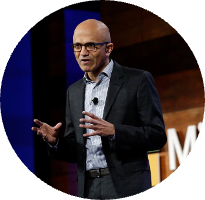
“Organizations that thrive are not those that resist change, but those that embrace it with agility and open-mindedness.”
Satya Nadella, Microsoft CEO
In the context of AI transformation, this perspective is particularly relevant because AI adoption requires not just new technologies but also a fundamental shift in culture, leadership, and operational processes.
Companies that proactively integrate AI while fostering adaptability among employees are more likely to see long-term success. However, industries like financial services and healthcare have faced particular challenges in adapting due to strict regulations, legacy systems, and concerns about ethical AI implementation.
Addressing these complexities requires strong leadership, clear AI policies, and ongoing workforce training to ensure responsible and effective integration. However, many organizations face challenges such as employee resistance to change, a lack of structured upskilling programs, and uncertainty about how AI will impact existing workflows. Addressing these obstacles requires clear communication, leadership buy-in, and a commitment to continuous learning. For example, Microsoft’s AI Academy has trained thousands of workers, helping them develop the skills necessary for AI adoption.
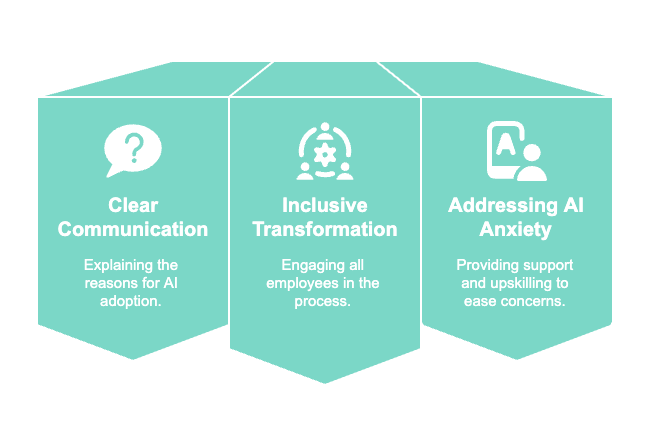
This means:
Clear communication on the why behind AI adoption.
Inclusive transformation—engaging employees at all levels, not just leadership.
Addressing AI anxiety with transparency, support, and upskilling programs.
3. Shift the Mindset: AI is About Augmentation, Not Replacement
Companies that see AI as a replacement tool often face resistance due to concerns over job security, lack of AI-related skills, and organizational inertia.
For example, when IBM introduced AI-driven automation in its customer service operations, the initial pushback from employees was mitigated through comprehensive retraining programs. By positioning AI as a way to enhance human expertise rather than replace it, IBM successfully transitioned its workforce to focus on more complex, high-value tasks.
Employees may fear displacement, while leadership may struggle with integrating AI without disrupting existing workflows. Addressing these concerns requires clear communication, reskilling initiatives, and a focus on AI as an augmentation tool rather than a substitute. Salesforce’s AI-driven solutions, such as Agentforce, demonstrate how AI can be leveraged to augment rather than replace human efforts, ensuring smoother adoption and integration across departments. Instead, the most successful implementations position AI as an augmenter of human potential:
Automate repetitive tasks to free up time for creative and strategic work.
Enhance human decision-making with predictive analytics and AI-driven insights.
Foster collaboration between AI and human teams (e.g., AI-assisted content creation, smart sales enablement).
4. Tackle the Innovation-Adoption Gap Head-On
The AI lag isn’t just a technology issue—it’s a leadership and process issue. Companies like Microsoft and Salesforce have successfully tackled this challenge by embedding AI literacy programs at every level and ensuring cross-functional collaboration between technical and business teams. Their approach demonstrates that AI adoption is most effective when driven by strong leadership, clear strategic intent, and a culture of continuous learning.
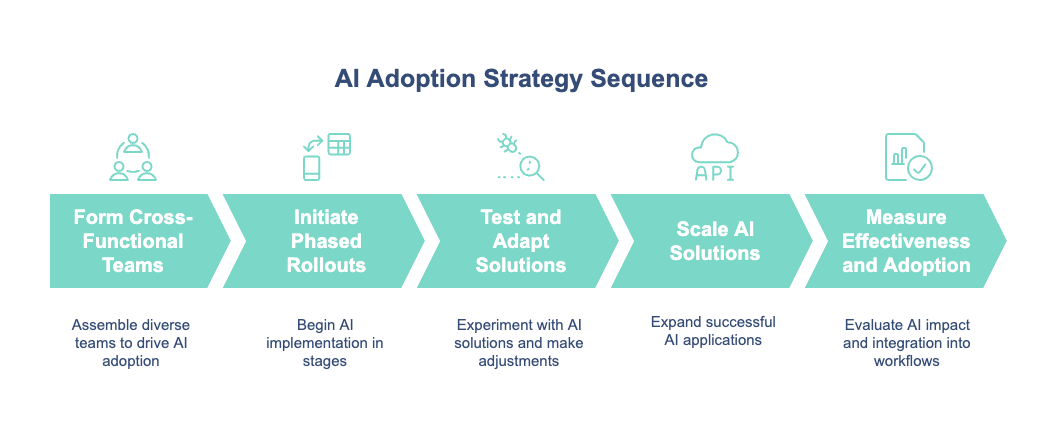
Cross-functional AI adoption teams: Bring together tech leaders, business strategists, and end-users.
Phased rollouts with iterative learning: Test, adapt, and scale AI solutions gradually.
Measure both AI effectiveness and human adoption rates: Adoption isn’t just about implementation—it’s about integration into daily workflows.
The Road Ahead: Leading AI Transformation with a Strong “Why”
“Great leaders don’t motivate by fear of change, but by giving a powerful ‘Why’.”
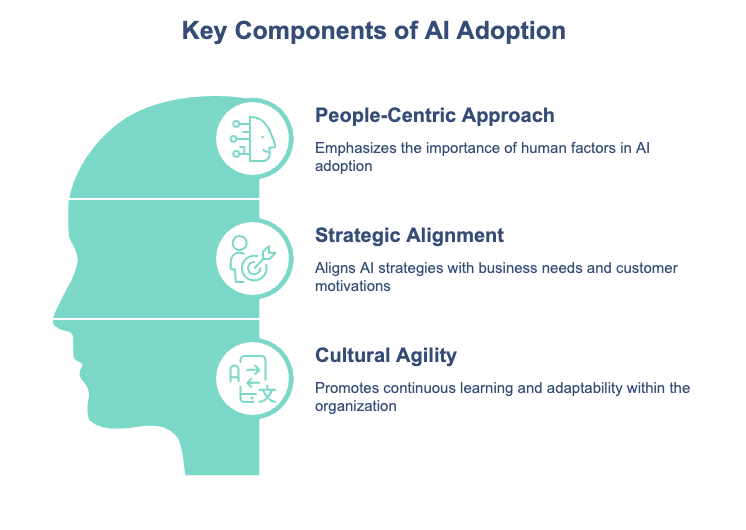
The discussions at Numeum Camp 2025, a key event for tech industry leaders navigating AI adoption, made one thing clear: AI is not a distant future to anticipate—it’s a present to build. Organizations that thrive in the AI era will be those that:
✅ Understand that people—not just technology—are the key to AI adoption.
✅ Align AI strategies with real business needs and customer motivations.
✅ Cultivate a culture of continuous learning and agility.
The future of work is being shaped right now—how is your organization preparing for it? With AI becoming an integral part of business strategy, companies that invest in AI literacy, embrace augmentation over replacement, and prioritize change management will be best positioned for success. A great first step is conducting an AI readiness assessment to identify skill gaps, operational bottlenecks, and areas where AI can drive meaningful impact. By taking this proactive approach, companies can build a structured roadmap for sustainable AI integration.
💬 AI adoption is accelerating—will your business lead or lag behind? Share your challenges and successes in the comments.
With over 30 years of experience in software, I’ve had the opportunity to work as an entrepreneur and international executive for some of the biggest names in tech, including Lotus, IBM, Peoplesoft, Sun Microsystems, Sage, Salesforce, and Oracle. As a former EMEA Vice President of Marketing and Global Chief Product Officer, I gained invaluable insights into the rapidly changing tech industry.
Today, I’m an Optimist Sr. Advisor, Executive Coach & Mentor, and public speaker. I’m thrilled to help teams of any size thrive in complexity, speed, and change, and to inspire transformation and innovation for impact. I’m passionate about empowering individuals and organizations to make a lasting mark on the world. If you want to learn more about my journey, please check out my bio and About for additional details
My motto: “Authentic leadership: unlocking the potential to achieve the impossible.”
View all posts by Emmanuel Obadia







 Emmanuel Obadia & Partners | Transform & Innovate