


“I’m not sure how many more cycles like this my team can survive.”
That’s what a CFO told me recently at the end of a Job-To-Be-Done (JTBD) interview. He looked exhausted. Month-end had gone off the rails — again. Two entities had sent data late. The auditor flagged inconsistencies. His CEO wanted answers.
And then he said the sentence that changed the entire conversation:
“Honestly? Our problem isn’t the tool. Our problem is that we crossed a line we didn’t see coming.”
That line — the threshold — is the real segmentation unit in B2B. Not industry. Not title. Not employees. Not a fancy Ideal Customer Profile (ICP).
And it’s the moment most Go-To-Market (GTM) teams never detect.
Your segmentation isn’t broken.
Your assumptions are.
Every week, I talk to leaders who feel their Go-To-Market has a segmentation problem. Their personas are polished, their ICP is crisp, and their Total Addressable Market (TAM) looks impressive on a slide.
- And yet their pipeline feels unpredictable.
- Deals stall without a clear reason.
- Messaging works brilliantly for some prospects… and completely misses others.
After running dozens of JTBD interviews this past month — especially with finance leaders for an Enterprise Performance Management/EPM+CSRD project — a truth emerged that is both simple and uncomfortable:
Most segmentation frameworks describe the market.
Very few describe the moment.
And in B2B, people don’t buy in demographics. They buy in moments.
The Illusion of the “Perfect Ideal Customer Profile”

Segmentation decks inside B2B companies are gorgeous. They have colors, matrices, quadrants, and sometimes even animal names.
But they all suffer from the same flaw:
They describe the market you wish you were selling to, not the one that is actually moving.
If you work in SaaS or B2B services, your segmentation probably looks like this:
- Industry
- Company size
- Region
- Title
- Tech stack
Nothing wrong with that. It’s a starting point.
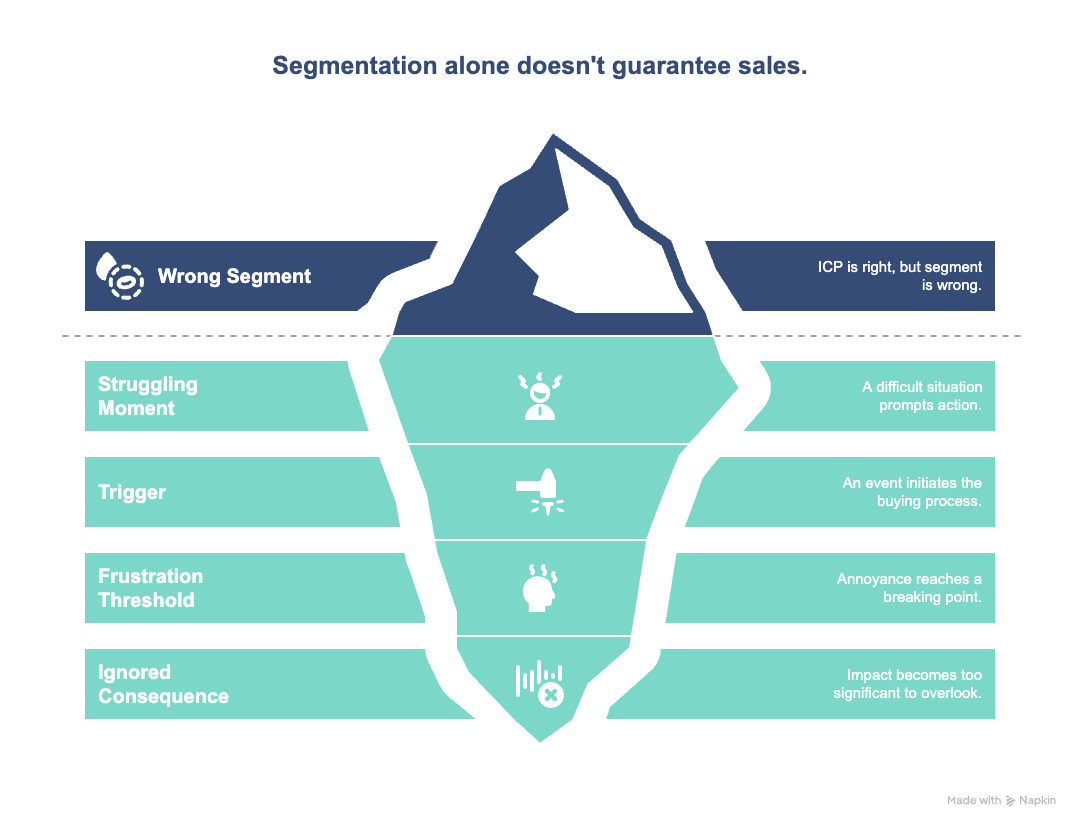
But here’s the paradox:
You can have the right ICP and still have the wrong segment.
Why? Because segmentation tells you who could buy.
It does not tell you who will buy now.
The energy of the deal — the will to change, the urgency, the tension — comes from something else entirely:
- A struggling moment.
- A trigger.
- A frustration that crossed the threshold.
- A consequence that became impossible to ignore.
Without this, you’re not talking to a buyer.
You’re talking to “someone in your ICP who is politely listening.”
When JTBD Interviews Reveal the Truth

If you ever want to humble a GTM team, sit with their customers and ask one simple question:
“Walk me through the moment you realized something had to change.”
This is where the veneer of the ICP collapses.
This is where the truth lives.
This is where real segmentation begins.
Over the past weeks, I’ve interviewed CFOs, Consolidation Directors, Group Reporting leaders, and Finance Transformation managers.
Different industries. Different maturities. Different tooling.
On paper?
Identical ICP.
In reality?
Completely different worlds.
Here’s what I heard:
- “We’re drowning every month-end. The team can’t sustain another cycle like this.”
- “Group reporting failed during the audit. We can’t risk a repeat.”
- “Our current tool kind of works… it’s not great, but it’s good enough.”
Same title.
Same company size.
Same reporting needs.
But only one of these leaders has the energy to buy.
The others have opinions, not tension.
And tension — not profile — is what drives deals.
The Real Strategic Unit: The Minimum Viable Segment (MVS)

Your MVS is:
The smallest group of buyers who share the same struggle, at the same moment, with the same urgency to act.
It’s not your ICP.
It’s not your persona.
It’s not your TAM.
It’s a behavioral, emotional, and operational cluster of buyers united by:
- A struggling moment they can’t ignore
- A progress they strongly desire
- A risk they now perceive as too high
- A willingness to change now, not “someday”
The MVS is where clarity lives.
It’s where messaging sharpens, cycles shorten, and deals cluster.
It’s also the segment where your product feels obvious.
Why Most Segmentation Fails in Practice
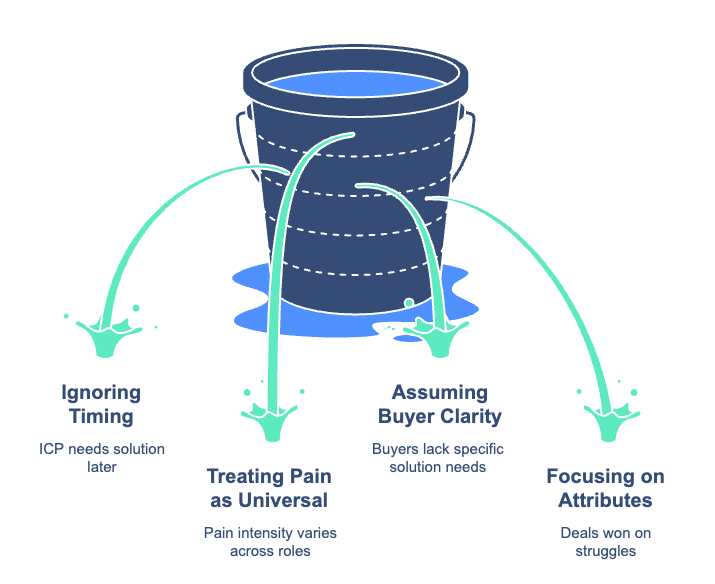
Let’s be blunt.
Most segmentation fails not because teams don’t know their market — but because they don’t know their moments.
1. It ignores timing
Your ICP may need your solution — but not today. Timing is everything in go-to-market.
2. It treats pain as universal
Not all CFOs have the same pain intensity.
Not all HR directors have the same urgency.
Not all IT leaders have the same constraints.
Intensity is segmentation.
3. It assumes the buyer has clarity
They often don’t.
A CFO doesn’t wake up thinking: “We need an MVS-specific EPM upgrade.”
They wake up thinking: “This reporting cycle is going to break my team.”
4. It focuses on attributes, not struggles
Titles are attributes.
Budgets are attributes.
Tech stack is an attribute.
But deals are won on struggles.
What Happened When We Looked for the MVS

Here’s the uncomfortable pattern that emerged across interviews — the part most GTM teams avoid because it forces hard choices:
Across the JTBD interviews, one segment kept resurfacing:
- Group-level finance teams under pressure from auditors
- Complex consolidation needs across entities
- A recent reporting incident or near-miss
- A loss of trust in their current tool or process
This segment didn’t just “fit” the ICP.
They shared the same struggling moment.
And here’s the magic: when you speak to an MVS, messaging becomes obvious.
We didn’t have to “sell” features.
We described the moment they were in.
We articulated the consequences they already felt.
We clarified the progress they desperately wanted.
And suddenly the conversation shifted from pitching to alignment.
Deals move faster when the buyer’s story is already in motion.
The Segmentation Reset GTM Leaders Need
Here’s the part nobody writes on their slides, but everyone feels deep down in their stomach, if I had to summarize months of work into one sentence:

Stop segmenting your market. Start segmenting your moments.
Look for:
- The trigger
- The struggle
- The threshold-crossing event
- The consequences of doing nothing
- The alternative solutions that have already failed
- The anxiety of making the wrong move
- The timeline of the last attempt to fix it
Because your real market is not defined by who they are.
It’s defined by what just happened in their world.
That’s your Minimum Viable Segment.
And it’s the growth lever most GTM teams ignore.
A Question for You
If you look at your current pipeline:
Do your best deals share more attributes… or more moments?
And how would your GTM change if you focused only on the segment that is already trying to make progress?
If you want my JTBD interview template — the exact one I use to uncover the MVS — reach out.

 Emmanuel Obadia & Partners | Transform & Innovate