

- SaaS Success Roadmap
- JTBD Framework Essentials
- JTBD Pricing Strategies
- Pricing Strategy Optimization
- Customer Value Mapping
- SaaS Pricing Examples
- Maximizing SaaS Business Potential
- Book a Consultation Call
The Jobs-to-be-Done (JTBD) framework and strategic pricing are essential tools for SaaS companies aiming to maximize their impact and drive sustainable growth. By focusing on the core tasks customers need to accomplish and aligning product features and pricing models accordingly, businesses can develop targeted solutions, craft resonant messaging, and create compelling value propositions that justify premium pricing and enhance customer satisfaction.
SaaS Success Roadmap

The Jobs-to-be-Done (JTBD) framework is a powerful methodology that shifts the focus from product features to solving real customer problems in SaaS product marketing. Rather than fixating on demographics or superficial buyer personas, JTBD urges businesses to understand the core jobs customers are trying to accomplish when using a product or service.
This approach enables SaaS companies to:
- develop offerings that address genuine customer needs,
- craft resonant messaging,
- improve sales and customer success,
- drive innovation,
- and align the entire organization around a shared purpose.
By implementing JTBD, SaaS businesses can gain a competitive edge in a crowded market and create more meaningful connections with their user base.
JTBD Framework Essentials
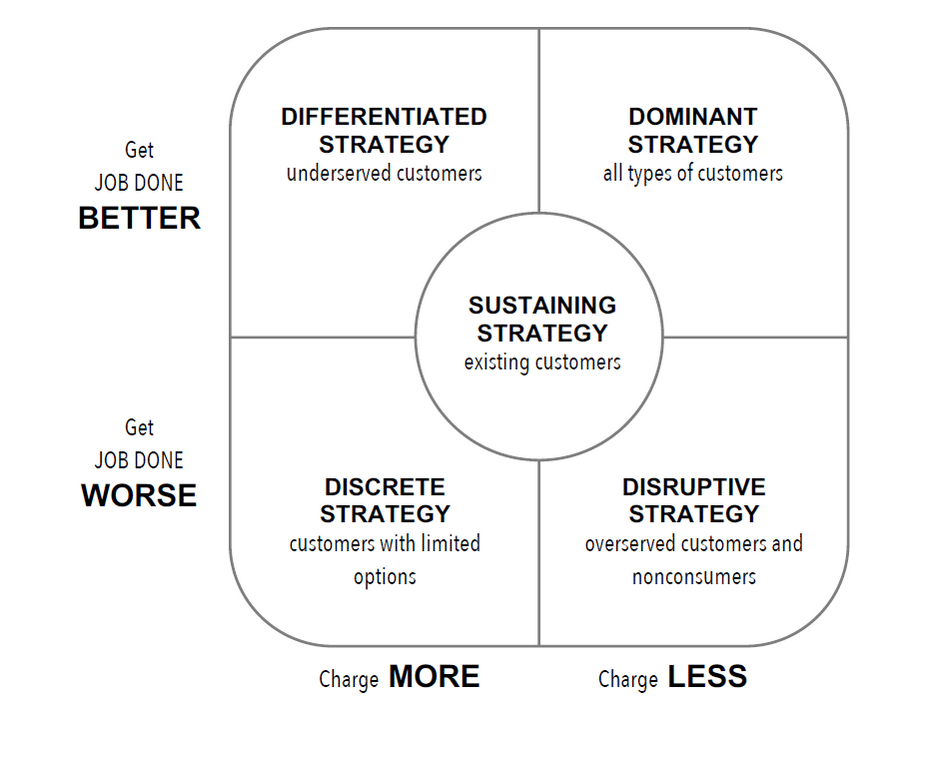
The Jobs-to-be-Done (JTBD) framework is powerful for understanding customer needs and driving product development in the SaaS industry. It shifts the focus from product features to the underlying tasks or “jobs” customers are trying to accomplish to make progress. This approach enables SaaS companies to create more targeted and effective solutions.
Definition and Importance of JTBD
JTBD is based on the principle that customers “hire” products to fulfill specific needs or complete particular tasks. By understanding these jobs, SaaS companies can:
- Focus on customer needs rather than demographic segmentation
- Build motivation-led products that address core user problems
- Avoid inaccurate customer segmentation based solely on demographics
Methods for Identifying Core JTBD
Customer Interviews and Surveys 🎧
Direct engagement with customers is crucial for uncovering their JTBD:
- Conduct user interviews with open-ended questions like “What are you trying to accomplish?” or “What challenges are you facing in your workflow?”
- Deploy comprehensive surveys to gather quantitative data supporting qualitative insights
- Analyze usage analytics to identify features with high engagement, signaling core jobs the product is fulfilling
JTBD Canvas Framework 📋
The JTBD Canvas, check on the version 2.0 at the beginning of this post, is a structured tool for mapping customer jobs:
- Identify the job executor, product lifecycle support team, and buyer
- Define five types of jobs: core functional, related jobs, emotional jobs, consumption chain jobs, and purchase decision jobs
- Include functional, emotional, and social dimensions of each job
Aligning Product Features with JTBD 𝌻
Once core jobs are identified, SaaS companies should:
- Prioritize features based on how effectively they address identified jobs
- Use iterative prototyping to refine features until they meet job requirements effectively
- Set up collaborative workspaces (e.g., Trello, Jira) to categorize feature requests and bugs under specific customer jobs
Continuous Adaptation and Feedback 🛠️
Customer jobs evolve over time, requiring ongoing attention:
- Conduct regular user interviews to track changing jobs and emerging needs
- Implement feedback portals (e.g., UserVoice, Canny) for direct user input
- Create online communities and forums for users to discuss experiences and challenges
- Perform usability testing to identify friction points in job completion
By implementing the JTBD framework, SaaS companies can create more targeted offerings, improve customer satisfaction, and drive sustainable growth in a competitive market.
JTBD Pricing Strategies
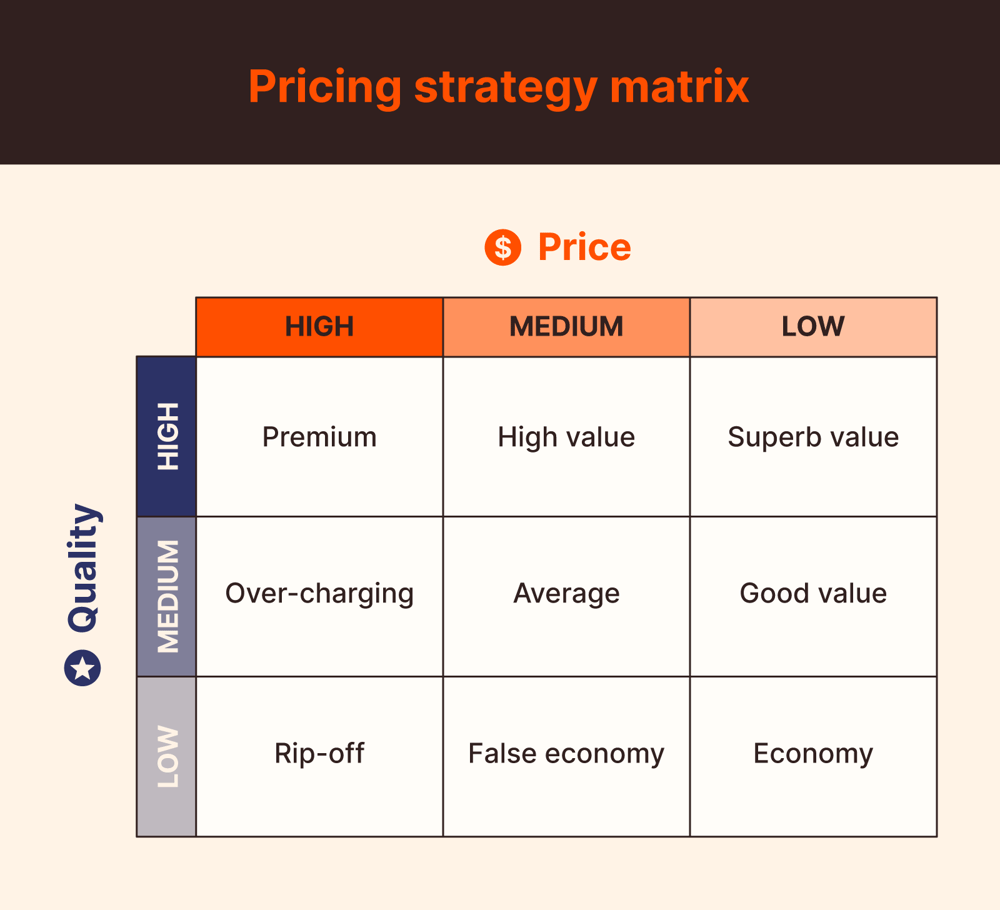
The Jobs-to-be-Done (JTBD) framework offers valuable insights for developing effective pricing strategies in the SaaS industry. By understanding the core jobs customers are trying to accomplish, companies can create pricing models that align with the value they provide and maximize revenue potential.
Value-Based Pricing
Value-based pricing is a strategy that sets prices based on the perceived value to the customer rather than production costs. By leveraging JTBD insights, SaaS companies can more accurately gauge the value their product delivers and price accordingly. This approach involves:
- Identifying the key outcomes customers seek when using the product
- Quantifying the value of achieving these outcomes in customer terms
- Setting prices that reflect a portion of this value, ensuring customers still perceive a net benefit
For example, if a SaaS product helps businesses increase sales by 20%, the pricing could be set as a percentage of this additional revenue, ensuring alignment between cost and value delivered.
HubSpot: HubSpot uses value-based pricing by aligning its pricing with the value its marketing and sales software provides to businesses. They focus on the outcomes their customers achieve, such as increased lead generation and sales, and price their products accordingly.
Tiered Pricing Models
Tiered pricing allows SaaS companies to cater to different customer segments with varying needs and budgets. Each tier should be designed to address specific jobs-to-be-done, providing a clear upgrade path as customers’ needs evolve. When implementing tiered pricing:
- Identify distinct customer segments based on their JTBD
- Create feature sets that align with each segment’s core jobs
- Ensure clear differentiation between tiers to encourage upgrades
- Use JTBD insights to communicate the value proposition of each tier
Slack: Slack offers tiered pricing with different levels such as Free, Pro, Business+, and Enterprise Grid. Each tier provides a set of features tailored to the needs of different types of users, from small teams to large enterprises.
Freemium Models
The freemium model, where a basic version of the product is offered for free, can be an effective way to attract users and demonstrate value. When designing a freemium model based on JTBD:
- Ensure the free version addresses fundamental jobs-to-be-done
- Reserve premium features for higher-value jobs that justify the cost
- Use JTBD insights to guide users towards paid features that solve their specific challenges
This approach allows users to experience the core value of the product while creating incentives for upgrading to access more advanced functionality.
Spotify: Although primarily a music streaming service, Spotify’s model is often cited in SaaS discussions. It offers a free version with ads and limited features, while the premium version removes ads and adds features like offline listening.
Outcome-Driven Pricing
Outcome-Driven Innovation (ODI), a methodology built on JTBD principles by Tony Ulwick, can inform pricing strategies by focusing on the degree to which a product satisfies all customer needs associated with getting a job done. This approach involves:
- Identifying 50-150 metrics (desired outcomes) that customers use to assess product performance
- Evaluating how well the product satisfies these metrics
- Setting prices based on the product’s ability to deliver desired outcomes
By linking pricing directly to job performance, companies can justify premium prices for products that excel at helping customers achieve their goals.
Gainsight: Gainsight, a customer success platform, uses outcome-driven pricing by tying its pricing to the success metrics and outcomes that its clients achieve, such as reduced churn and increased customer satisfaction.
Dynamic Pricing
Dynamic pricing involves adjusting prices based on demand, customer behavior, or market conditions. By leveraging JTBD insights, SaaS companies can implement dynamic pricing strategies that reflect the real-time value their product provides. This could involve:
- Adjusting prices based on the specific jobs a customer needs to accomplish
- Offering temporary discounts for new job-related features to encourage adoption
- Implementing usage-based pricing that aligns with the frequency or complexity of jobs performed
By tailoring pricing to the specific value delivered for each customer’s jobs-to-be-done, SaaS companies can optimize revenue while ensuring customers perceive fair value for their investment.
Uber: Although not a traditional SaaS company, Uber’s dynamic pricing model is a well-known example. Prices fluctuate based on demand, time of day, and other factors, reflecting the real-time value of the service provided.
Pricing Strategy Optimization

Implementing and optimizing pricing strategies in SaaS requires a data-driven approach that leverages the Jobs-to-be-Done (JTBD) framework. By conducting pricing experiments and analyzing customer feedback and usage data, companies can refine their pricing models to maximize value for both customers and the business.
Conducting Pricing Experiments
Pricing experiments, particularly A/B tests, are crucial for determining the most effective pricing strategy. When conducting these experiments:
- Set up A/B tests with different price points or pricing structures for the same product or feature set.
- Ensure statistical significance by selecting an appropriate sample size and defining a clear confidence level, typically 95%.
- Use reliable A/B testing tools like Figpii to manage experiments and track results.
When designing pricing experiments based on JTBD:
- Create variations that align with different customer segments’ core jobs.
- Test comparative pricing models that offer basic, standard, and premium plans to address varying levels of job complexity.
- Experiment with bundled pricing for complementary features that help customers complete related jobs.
It’s important to note that while A/B testing prices directly can be insightful, it may also create confusion or negative perceptions if customers discover price discrepancies. To mitigate this:
- Consider testing prices on similar products within the same category rather than identical items.
- Ensure consistent pricing across geographical regions to maintain brand integrity.
Analyzing Customer Feedback and Usage Data
Continuous analysis of customer feedback and usage data is essential for refining pricing strategies:
- Implement user feedback surveys to gather insights on pricing perceptions and value alignment.
- Use tools like Hotjar, by Content Square, to visualize how users interact with pricing pages and features, providing context to quantitative data.
- Analyze usage patterns to identify which features are most valuable in completing specific jobs, informing potential adjustments to pricing tiers.
When analyzing data through the JTBD lens:
- Look for correlations between feature usage and successful job completion rates.
- Identify which pricing tiers are most popular among different customer segments and their associated jobs.
- Use qualitative feedback to understand the perceived value of your product in relation to the jobs it helps complete.
Iterative Optimization
Pricing optimization should be an ongoing process:
- Regularly review and update your pricing strategy based on experiment results and data analysis.
- Consider implementing dynamic pricing models that adjust based on customer behavior and job completion patterns.
- Use fake door testing to gauge interest in new features or pricing models before full implementation.
Communicating Value
As you refine your pricing strategy, it’s crucial to effectively communicate the value proposition:
- Frame pricing tiers in terms of the jobs they help customers accomplish rather than just listing features.
- Use JTBD insights to create compelling marketing messages that resonate with customers’ core needs.
- Provide clear explanations of how each pricing tier or feature contributes to successful job completion.
By consistently aligning pricing experiments and analysis with the JTBD framework, SaaS companies can develop pricing strategies that accurately reflect the value they provide to customers. This approach not only optimizes revenue but also ensures that customers feel they are getting fair value for their investment, leading to improved satisfaction and retention.
Customer Value Mapping
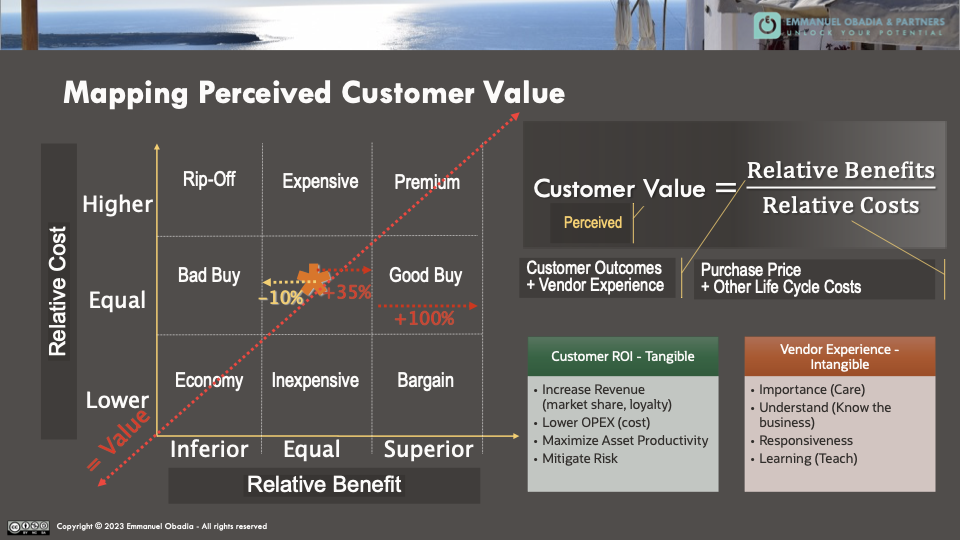
Customer Perceived Value (CPV) is a critical metric in the SaaS world, representing the ratio between the relative benefit and the relative total customer cost, relative i.e. compared to competition. You want this ratio to be greater or equal to one. This concept is particularly relevant for SaaS companies as they strive to create and communicate value to their customers.
The customer value equation can be expressed as:
Customer Value Perceived = Relative Benefits / Relative Costs
This equation encompasses both tangible and intangible factors. Tangible outcomes include increased revenue and lower operational costs, while intangible experiences involve aspects such as vendor responsiveness and understanding of customer needs.
To effectively map and interpret customer-perceived value, SaaS companies can use a value map with the following quadrants:
- Inferior Value: This quadrant represents low benefits relative to costs. Products or services in this category are often perceived as a “bad buy” or “rip-off” by customers.
- Equal Value: Here, benefits and costs are relatively balanced. Offerings in this quadrant are typically seen as “inexpensive” or “economy” options.
- Superior Value: This is the ideal position, where benefits are high relative to costs. Products in this category are perceived as a “good buy” or “bargain”.
SaaS companies should aim to position their offerings in the Superior Value quadrant to justify premium pricing and enhance customer satisfaction. This can be achieved through various strategies:
- Feature Optimization: Ensure that product features directly address the core jobs customers need to accomplish. This aligns with the Jobs-to-be-Done (JTBD) framework and increases perceived benefits.
- User Experience: Invest in creating a seamless and intuitive user interface. A positive user experience can significantly boost the intangible value of a SaaS product.
- Customer Support: Provide exceptional customer support to enhance the overall perceived value. This includes responsive communication, proactive problem-solving, and personalized assistance.
- Transparent Pricing: Clearly communicate the value proposition of each pricing tier, helping customers understand the benefits they receive relative to the cost.
- Proof of Value: Utilize methods such as free trials, case studies, and testimonials to demonstrate the product’s tangible benefits. This helps potential customers visualize the value they’ll receive.
- Continuous Improvement: Regularly update and enhance the product based on customer feedback and evolving needs. This ongoing commitment to improvement can justify higher pricing and maintain a superior value perception.
By focusing on these strategies and consistently delivering high value, SaaS companies can position themselves favorably in the customer’s perceived value map. This not only justifies premium pricing but also leads to higher customer satisfaction, loyalty, and ultimately, increased Customer Lifetime Value (CLV).
SaaS Pricing Examples
Example 1: Slack
Slack effectively leverages the Jobs-to-be-Done (JTBD) framework to inform its product strategy and pricing model. The company’s approach focuses on addressing the core job of reducing information overload and facilitating efficient team communication.
Slack’s freemium model addresses basic communication needs, allowing teams to experience the platform’s value before committing to a paid plan. This strategy aligns with the JTBD principle of helping customers accomplish their primary goal – streamlining team communication – while providing a clear path to more advanced features as their needs evolve.
Key aspects of Slack’s JTBD-informed strategy include:
- Targeting the right customers: Slack focuses on teams that struggle with email overload and need faster, more collaborative communication tools.
- Product features: The platform’s channels, direct messaging, and integrations are designed to address specific communication challenges faced by teams.
- Tiered pricing: Slack offers different plans (Free, Pro, Business+, and Enterprise Grid) that cater to varying team sizes and communication needs, allowing customers to choose the tier that best fits their job requirements.2
However, Slack’s strategy also highlights potential areas for improvement:
- Reducing communication overload: While Slack aims to streamline communication, it can sometimes lead to its own form of information overload. Competitors could potentially beat Slack by focusing on helping teams communicate more efficiently with fewer messages.
- Targeting specific industries: Slack’s generalized approach could be vulnerable to competitors who tailor their solutions to specific industries or job functions, addressing unique JTBD for those segments.
Example 2: HubSpot
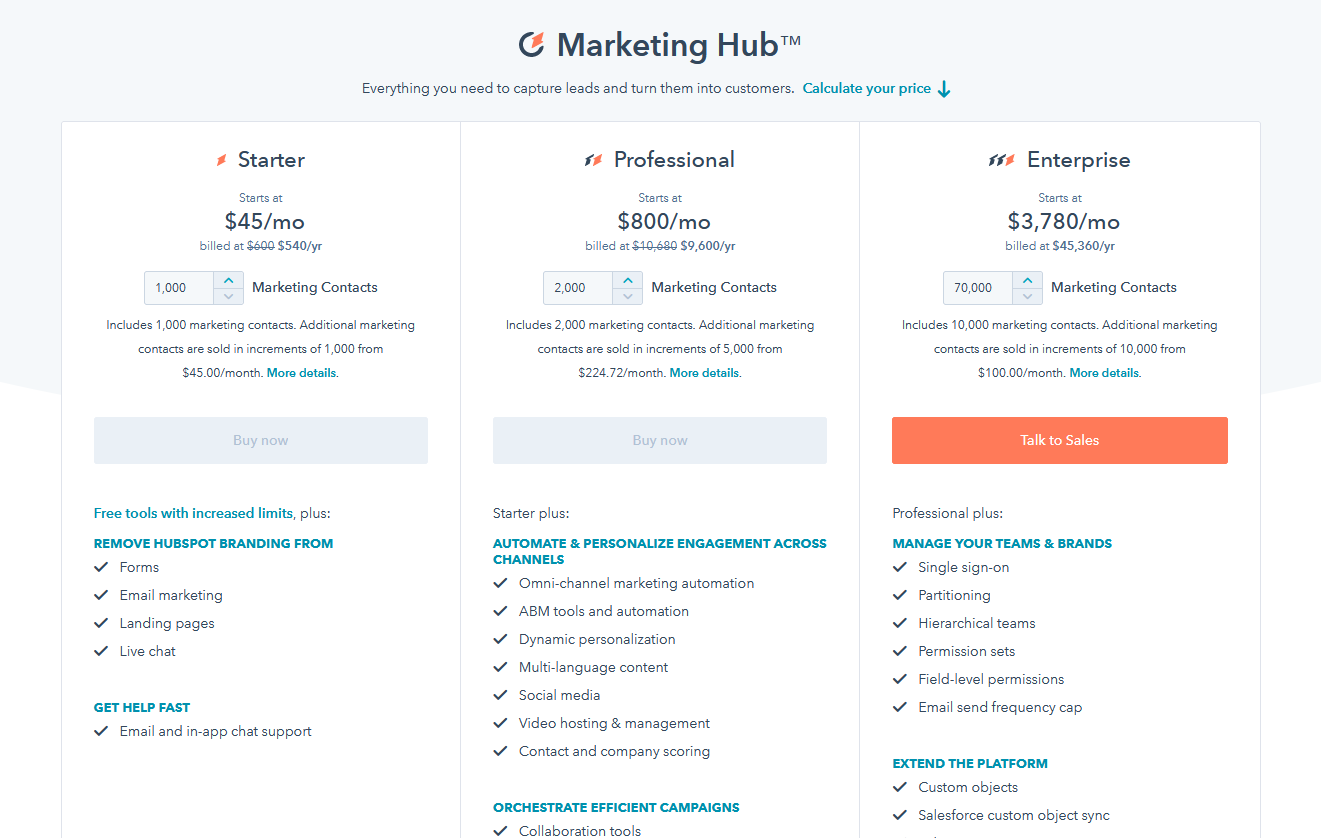
HubSpot demonstrates a sophisticated application of the JTBD framework in its pricing strategy, offering tiered packages that cater to businesses of different sizes and with varying needs. This approach reflects HubSpot’s understanding that companies have different jobs to be done depending on their growth stage and marketing sophistication.
HubSpot’s JTBD-informed pricing strategy includes:
- Starter, Professional, and Enterprise tiers: These distinct packages are designed to address the specific needs of startups, growing businesses, and large enterprises respectively.
- Bundled solutions: HubSpot offers Marketing Hub, Sales Hub, and Service Hub, allowing businesses to choose the tools that align with their primary jobs to be done.
- Scalable pricing: As businesses grow and their jobs become more complex, they can easily upgrade to higher tiers with more advanced features.
Key benefits of HubSpot’s approach:
- Clear value proposition: Each tier clearly communicates the jobs it helps customers accomplish, making it easier for businesses to choose the right package.
- Flexibility: The ability to mix and match different hubs allows companies to create a customized solution that addresses their specific JTBD.
- Growth-oriented: The tiered structure encourages customer growth and increased adoption of HubSpot’s tools over time.
Both Slack and HubSpot demonstrate how understanding and applying the JTBD framework can lead to more effective product development and pricing strategies in the SaaS industry. By focusing on the core jobs their customers need to accomplish, these companies have created flexible, value-driven pricing models that cater to a wide range of user needs and drive long-term customer retention and growth.
Maximizing SaaS Business Potential

Integrating the Jobs to Be Done (JTBD) framework with strategic pricing is a powerful approach for SaaS businesses to optimize their offerings and drive growth. By deeply understanding customers’ core needs and aligning product features and pricing models accordingly, companies can create compelling value propositions that resonate with users and justify premium pricing.
The JTBD framework shifts focus from product features to the underlying tasks customers aim to accomplish. This customer-centric approach enables SaaS companies to:
- Develop targeted solutions that address genuine customer needs
- Craft messaging that resonates with users’ motivations
- Align product development, marketing, and sales efforts around customer success
- Drive innovation by identifying unmet or poorly served jobs
When combined with strategic pricing, JTBD insights can inform value-based pricing models that accurately reflect the worth of solutions to customers. Key pricing strategies enhanced by JTBD include:
- Tiered pricing models tailored to different customer segments and job complexities
- Freemium offerings that address basic jobs while incentivizing upgrades for advanced needs
- Dynamic pricing that adjusts based on the value delivered for specific jobs
- Outcome-driven pricing linked to measurable job performance metrics
To effectively implement JTBD-informed pricing:
- Conduct thorough customer research to uncover core jobs and desired outcomes
- Map product features and pricing tiers to specific jobs-to-be-done
- Perform A/B testing to optimize pricing structures and communicate value effectively
- Continuously analyze customer feedback and usage data to refine offerings
By positioning products in the “Superior Value” quadrant of the customer value map, SaaS companies can justify premium pricing while ensuring high customer satisfaction. This involves balancing tangible benefits (e.g., increased revenue, lower costs) with intangible factors (e.g., ease of use, vendor responsiveness) to create a compelling overall value proposition.
Successful implementation of JTBD and strategic pricing is exemplified by companies like Slack and HubSpot. Slack’s freemium model addresses basic communication needs while offering premium tiers for advanced organizational requirements. HubSpot’s tiered pricing caters to businesses of varying sizes and complexities, with distinct packages for startups, growing companies, and enterprises.
By embracing the JTBD framework and aligning it with strategic pricing, SaaS businesses can create more targeted offerings, improve customer satisfaction, and drive sustainable growth in an increasingly competitive market.
This approach not only optimizes revenue but also fosters deeper, more meaningful connections with users by addressing their core needs and delivering tangible value.
Book a Consultation Call

If you’re interested in implementing Jobs to Be Done (JTBD) and strategic pricing strategies to optimize your SaaS business, but feel you could benefit from expert guidance, consider booking a complimentary consultation with me. As an experienced practitioner, as a Global Chief Product Officer at Sage, and EMEA Vice President of Marketing at Sazlesforce and Oracle, I can provide personalized insights and actionable advice tailored to your specific business needs.
During the call, we can:
- Assess your current pricing strategy and identify areas for improvement
- Discuss how to effectively apply JTBD principles to your product development and marketing efforts
- Explore potential pricing models that align with your customers’ core jobs and perceived value
- Provide guidance on conducting customer research and pricing experiments
To schedule your complimentary call, use this link or contact me via Linkedin. Our goal is to help you unlock the full potential of your SaaS business by leveraging JTBD insights and strategic pricing approaches

 Emmanuel Obadia & Partners | Transform & Innovate
One thought on “Unlocking SaaS Potential: Harnessing Jobs to Be Done and Strategic Pricing for Maximum Impact”