

Do you know the actual state of our world? Recently, I found myself absorbed in a fascinating book titled “Factfulness” by Hans Rosling, highly recommended by President Obama or Bill Gates. A powerful exposé of the misconceptions we harbor about our world, the book unravels ten inherent instincts that distort our perspective, subsequently affecting our strategies, investments, and actions. My main concern, as much as I progressed into the book, was that our leaders were building erroneous strategies, misguided investments, and misplaced actions, especially in dealing with pivotal issues such as the planet’s sustainability and social issues among the UNO 17 Sustainable Development Goals (UNO SDGs) as defined after the 2015 Paris accord (COP 21). But it also highlighted how business leaders were missing some key ingredients of a successful global business strategy and go-to-market deployment, let alone product market fit.
“The overdramatic worldview is so difficult to shift because it is now so easy to construct an alternative reality that fits your worldview and to find others who share your views.”
Hans Rosling in ‘Factfulness’
A Quick Quiz: Questioning Our Understanding
Let’s begin our journey of discovery with a quick quiz! Here are three questions to test your understanding of the world:
- Where does the majority of the world’s population live?
- A. Low-income countries
- B. Middle-income countries
- C. High-income countries
- In the last 20 years, the proportion of the world population living in extreme poverty has…?
- A. Almost doubled
- B. Remained more or less the same
- C. Almost halved
- How many of the world’s one-year-old children have been vaccinated against some disease?
- A. 20%
- B. 50%
- C. 80%
Hold on to your answers and write them down, we will revisit them at the end to unravel the biases they might be rooted in.
Beyond ‘Developed’ and ‘Developing’: The Four Income Levels
“The idea of classifying countries as developed and developing is worse than useless.”
Hans Rosling in ‘Factfulness’
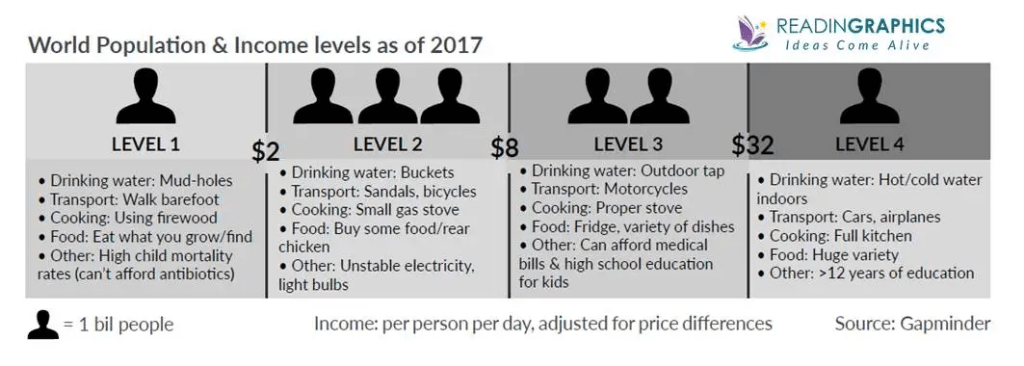
Rosling proposes a modern perspective that transcends the outdated dichotomy of “developed” and “developing” countries and suggests a more nuanced understanding of global economic disparity, dividing the world’s population into four income levels based on daily income. This framework challenges the oversimplified dichotomy of “developed” and “developing” countries which is in fact based on a view of the world coming from the 60s. The progression through these levels is well illustrated by the evolution of transportation means, from walking barefoot to owning a car.
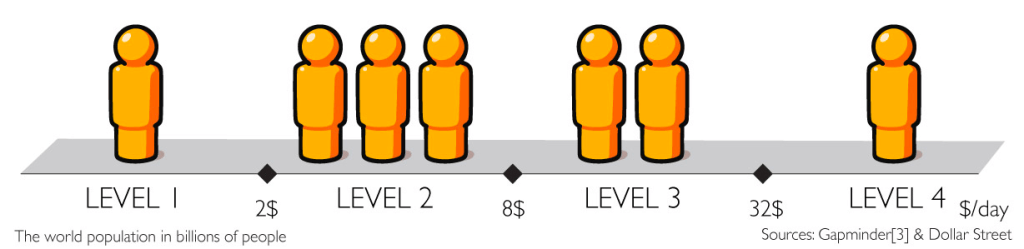
What is even more striking, that you can check on gapminders.org fantastic project Dollar Street, is that the behavior of people, their way of living, and for instance the nature of their toothbrushes or shoes is ONLY dependent on the level of their daily income against these four categories. Chances are that if you’re reading this post, you are in a level 4 country or at level 4 yourself in a level 3 country and you missed the fantastic evolution of mankind in the last 80 years. This isn’t a personal failing, most people regardless of their level of education, income, religion, gender, or else failed this test big time — our misconceptions are born out of ten fundamental human instincts that Rosling identifies.
Unmasking Our Biases: The Ten Instincts That Distort Our Perspective
Now, let’s dissect each of the ten instincts Rosling identifies in “Factfulness,” using real-world examples to ground our understanding:
- 🌍 The Gap Instinct – This instinct can be illustrated by our tendency to separate the world into “developed” and “developing” countries, failing to realize there are varying degrees of development, as per Rosling’s four income levels (see graphic above). What is your view?
- 😔 The Negativity Instinct – The media often focuses on dire issues like poverty and violence, causing us to overlook the progress we’ve made. For instance, global poverty rates have halved in the past 20 years, a fact often overlooked. How do you react to this?
- 📈 The Straight Line Instinct – We often assume trends will continue at the same rate. For instance, while the world population is increasing, the rate of growth is slowing down – it’s not a straight-line increase. According to UNO projections, it will cap around 11 Billion people in 2100. Did you know this?
- 😱 The Fear Instinct – Headlines about terrorism or pandemic diseases capture our attention more than positive news, skewing our understanding of real dangers. According to the Global Terrorism Database, in 2017, there were a little over 1,000 deaths caused by terrorism in all high-income countries combined, you can check more recent figures here. While any death is tragic, this number is relatively small compared to other causes of death. For instance, according to the World Health Organization, in 2017, diseases like heart disease and stroke claimed the lives of more than 17.8 million people globally. Surprised?
- 📏 The Size Instinct – We might think that immigration is a massive issue based on media focus, while data shows that in 2020 only about 3.6% of the world’s population are immigrants.
- 🌐 The Generalization Instinct – Assuming all people in a certain group behave the same way is a common mistake. For instance, viewing Africa as a single entity, not recognizing it’s a diverse continent with 54 unique countries. As an example, according to the World Bank, as of 2021, Mauritius had a Gross National Income (GNI) per capita of over $9,920, putting it on par with some Eastern European countries. On the other hand, Madagascar had a GNI per capita of just over $490, making it one of the world’s poorest countries. Would you reconsider your go-to-market in Africa?
- 🚀 The Destiny Instinct – We might assume certain cultures or regions are destined to remain poor due to inherent characteristics, overlooking the potential for change and development.
Take the example of South Korea. After the devastating Korean War, South Korea was one of the poorest countries in the world in the early 1960s. Many people, influenced by the Destiny Instinct, might have assumed that due to its war-torn history and lack of natural resources, South Korea was destined to remain poor. However, South Korea today tells a different story. It’s now an economic powerhouse, ranked as the 10th largest economy in the world in 2022 — Check this source by tapping on “Chart” to see a comparison with Europe and other regions. This transformation was driven by a number of factors including strong government policies, investments in education, and a focus on technological and industrial development. This example underscores how the Destiny Instinct can mislead us into thinking that the current state of affairs is unchangeable. What would you reconsider in your development plan? - 🔍 The Single Perspective Instinct – The issue of climate change, for example, cannot be fully understood from a single perspective. It requires a multidisciplinary approach considering economic, social, and technological viewpoints. You had also a glimpse of a systemic approach to addressing the COVID-19 global pandemic.
Economically, tackling climate change is not just about reducing carbon emissions; it’s also about shifting the global economy towards more sustainable industries and practices. This means rethinking how we use resources, how we generate energy, and even how we define economic growth.
From a social perspective, climate change has broad implications for social justice and equity. Poorer communities and countries, despite contributing the least to global emissions, often bear the worst of climate impacts. This adds a dimension of social equity to climate action – we need to ensure that efforts to mitigate climate change do not further exacerbate inequalities but instead contribute to a more equitable world.
Technologically, addressing climate change involves not just leveraging existing technologies, but also spurring innovation in green technologies. This could include advancements in renewable energy, carbon capture, energy-efficient devices, and more sustainable agricultural practices.
Understanding and addressing climate change, therefore, requires a multi-disciplinary approach. It calls for collaboration across sectors and disciplines, and an acknowledgment that effective solutions will need to address all these interconnected aspects. This example illustrates the dangers of the Single Perspective Instinct and highlights the need for a more comprehensive and nuanced understanding of complex global issues. - 🎯 The Blame Instinct – When a crisis occurs, we tend to seek a simple reason or scapegoat. Consider the 2008 financial crisis, the causes of which were numerous and interconnected, not caused by a single entity but by a combination of Banks and Financial Institutions, Credit Rating Agencies, Regulators and Policy Makers, and Individual Borrowers. Can you spot who you blame during your last business adversarial period?
- ⏰ The Urgency Instinct – This instinct can be seen in our responses to perceived imminent threats, such as buying excess supplies during a pandemic or selling stocks during a market dip, often exacerbating the problem. Hence by the way, why planet sustainability has a hard time capturing enough attention and more importantly concrete action: the urgency is not yet felt concretely enough.
To counter these instincts here are Rosling’s recommendations:

A Moment of Truth: Revisiting Our Answers
Now, let’s revisit the answers to the questions we posed at the beginning.
- Where does the majority of the world’s population live? The correct answer is B. Middle-income countries. This reflects the Gap Instinct, as we often perceive a stark divide between “rich” and “poor” countries, while in reality, a significant portion of the world population lives in middle-income countries, in line with Rosling’s four levels of income actually level 2 and 3.
- In the last 20 years, the proportion of the world population living in extreme poverty has…? The correct answer is C. Almost halved. This ties into the Negativity Instinct, as we often focus on the negative and overlook significant progress. Despite various challenges, we’ve made remarkable strides in reducing extreme poverty globally.
- How many of the world’s one-year-old children have been vaccinated against some disease? The answer is C. 80%. This illustrates both the Negativity and the Gap Instincts. Despite the prevailing belief that developing nations lag far behind in healthcare, the reality is that global vaccination efforts have been largely successful.
In shedding light on the correct answers, we realize how our preconceived notions, fueled by the ten instincts outlined in “Factfulness,” can skew our understanding of the world. This exercise underlines the importance of adopting a fact-based worldview and illustrates how we can begin to overcome our inherent biases. I’d encourage you to take the full test on gapminder, it’s free and enlightening.
A Call to Action and Hope
“The overdramatic worldview is so difficult to shift because it is now so easy to construct an alternative reality that fits your worldview and to find others who share your views.”
Hans Rosling in ‘Factfulness’
As we navigate the complexities of the 21st century, we must be aware of these instincts and their influence on our worldview. “Factfulness” shines a light on our blind spots, encouraging a more fact-based and nuanced perspective. In the face of global challenges such as climate change and social inequality, this book offers not just a call to action but a beacon of hope for a better understanding of our world.
As we navigate our global landscape, recognizing and challenging our inherent biases is crucial. But it can be difficult to do this alone. That’s where my expertise comes in. As a coach and mentor, previously a software entrepreneur and global executive at Big Tech companies, I’ve honed a unique approach to understanding global strategies and cultivating critical thinking skills. I offer personalized strategies to individuals and teams, guiding them in their journey to re-unite People, Planet, and Profit.
If you’re interested in developing these skills further, or if your team or organization could benefit from an in-depth workshop or an enlightening keynote speech, don’t hesitate to reach out. My coaching, mentoring, and public speaking services are designed to bring clarity amidst complexity, fostering understanding and strategic decision-making. Let’s embrace change, tame complexity and boost your business. Contact me directly to learn more or explore potential collaboration.
So, let’s ignite a conversation. Share this post on your social networks and encourage others to partake in the quiz. Let’s debunk the myths together and construct a fact-based worldview. I look forward to reading your comments and learning about your reactions to the quiz and the ideas in this post.
Finally, what other biases might be influencing our actions and decisions, especially regarding sustainability and climate change? Share your thoughts below. Let’s use ‘Factfulness’ as a springboard for a larger, necessary conversation.

 Emmanuel Obadia & Partners | Transform & Innovate