The AI Theater is Closing: How to Build a Revenue Engine That Actually Works
Executive Summary
The Problem: Corporate AI adoption is at 78% (McKinsey), but EBIT impact is lagging due to “AI Theater”—investing in tools without redesigning workflows.
The MVS Solution: To avoid a “Fuzzy GTM,” leaders must pivot to a Minimum Viable Segment (MVS)—targeting customer “moments” rather than static profiles.
The Agentic Future: We are moving toward a “No-Click” era where autonomous agents, not humans, will be the primary consumers of your top-of-funnel content.
The Bottom Line: Value realization requires a C-Suite mandate to rewire workflows, moving beyond individual “Hero Buyers” toward account-based intelligence.
Introduction: The Luxury Gym Membership Trap
In 2025, corporate innovation looks a lot like a January resolution. Organizations are rushing to buy the “luxury gym membership”—investing in high-priced Generative AI tools, glossy consulting frameworks, and impressive “innovation centers.”
But despite the shiny new equipment, nobody is actually sweating.
The irony is staggering. According to the latest McKinsey Global Survey, AI adoption has surged from 72% to 78% in a single year. Yet, for the vast majority of these firms, the impact hasn’t hit the bottom line.
Why? Because most are operating with a “Fuzzy Go-To-Market” (GTM)—a strategic haze where technology is bought to solve problems that haven’t been defined.
Buying a faster treadmill won’t help you if you’re running in the wrong direction. If you’re admiring the tools instead of doing the hard work of process redesign, you aren’t building a business; you’re just a spectator in the AI theater.
AI Doesn’t Create Performance; It Amplifies Your Flaws
The “Great AI Delusion” of 2025 is the belief that GenAI is a magic wand for revenue. It isn’t. AI is a high-powered amplifier.
If your GTM strategy is “fuzzy“—riddled with poor segmentation, weak messaging, and broken handoffs—AI will simply help you fail at a higher frequency.
Case Study: The “Personalization” Trap Consider a mid-market SaaS company that used AI to automate “personalized” outreach to 10,000 prospects. Because they hadn’t defined their Minimum Viable Segment (MVS), the AI sent highly specific messages to the wrong stakeholders at companies that weren’t ready to buy. The result? A 200% increase in “unsubscribe” requests and a tarnished brand reputation.
As noted in Harvard Business Review, moving from projects to profits requires a structural shift in how work is performed. The cure isn’t more data; it’s targeting the specific “moment” a customer is in. Real growth happens when you identify the trigger eventthat makes your solution a necessity, not just a luxury.
AI doesn’t create performance; it amplifies flaws—igniting faster failure rather than growth.
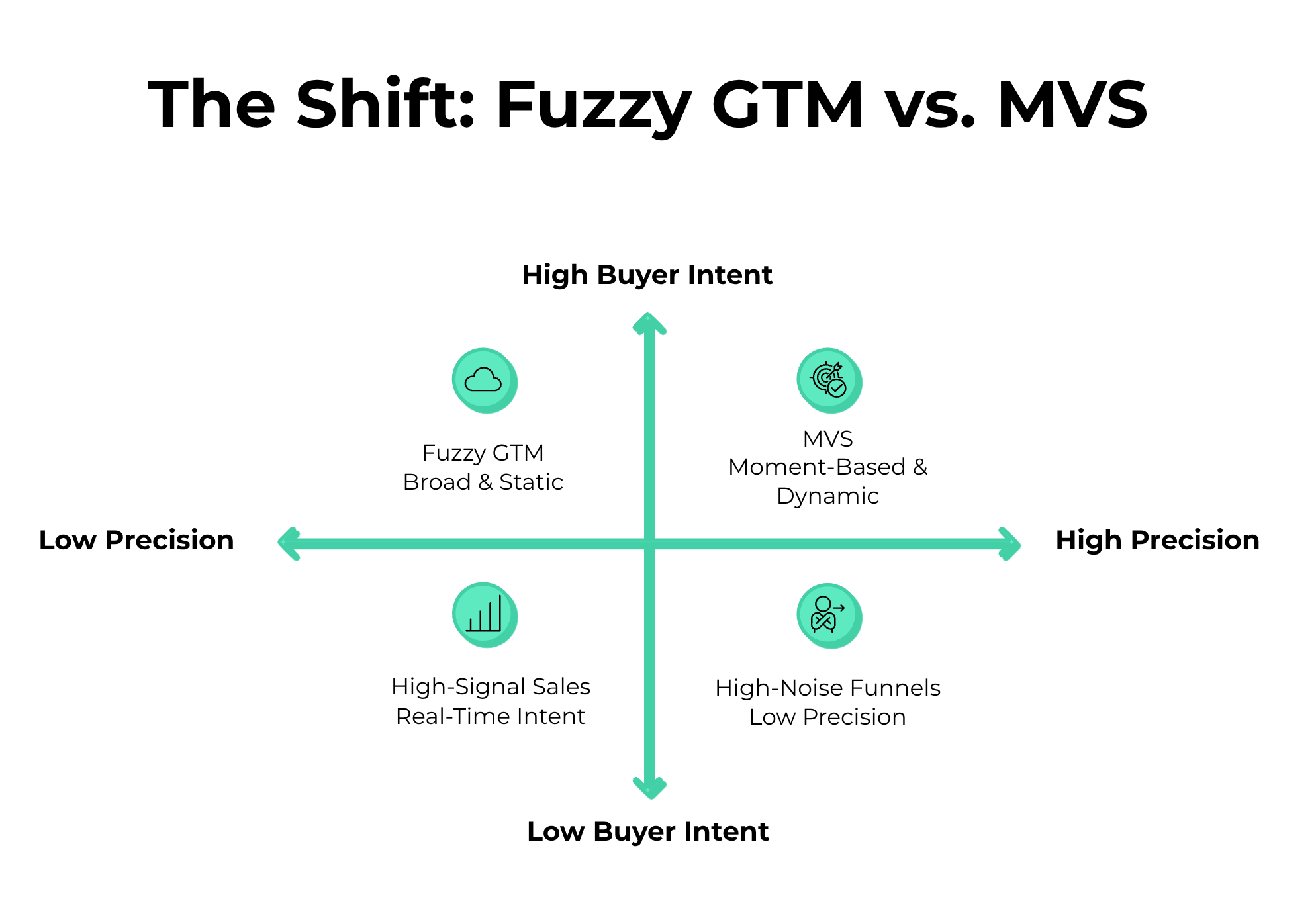
Traditional Go-To-Market strategies often miss real-time buyer intent. MVS focuses on dynamic signals, leading to higher conversions and ultimately better Net Revenue Retention.
The “Single-Buyer Myth” and the Rise of Buying Groups
Identifying the right “moment” is only half the battle; you must also understand who is in the room when that moment happens. The traditional B2B sales model is built on a lie: the “hero” buyer. Modern deal dynamics reveal a different truth: revenue is held by buying groups, not individuals.
According to Gartner research on the B2B buying journey, the typical buying group involves six to ten decision-makers. In complex enterprise deals, failing to engage the CFO or the IT security lead early on is often the silent killer of the “hero buyer” strategy.
To win today, you must subject your strategy to a “executive probation”—an executive stress-test. This rigor demands confronting academic models with the reality of scarce resources and “Customer Truth.” Success in 2026 requires moving from individual tracking to Account Intelligence, orchestrating engagement across the entire collective that actually holds the budget.
While account intelligence wins the initial deal, your revenue architecture determines if you keep it. In the SaaS world, offense wins games, but defense wins championships.
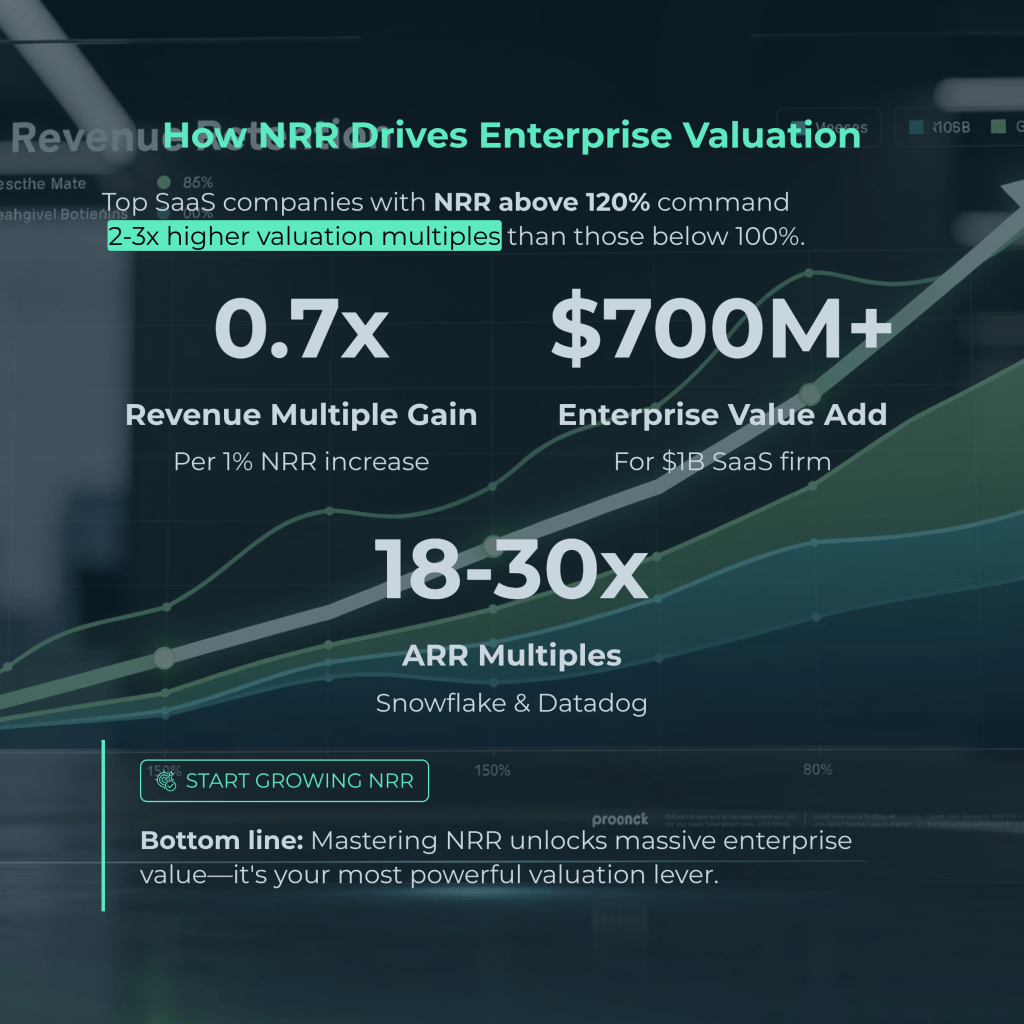
For years, retention was a secondary concern delegated to support. The data now proves this was a fatal strategic error. SaaS Capital benchmarks show that companies with the highest Net Revenue Retention (NRR) grow at double the population median.
Case Study: The Leaky Bucket Architecture A high-growth FinTech firm automated their sales engine using AI, leading to a 40% increase in new contracts. However, their post-sale handoff remained a manual, fragmented process. Within six months, churn spiked because the “promises” made by the AI-driven sales engine didn’t match the customer’s actual onboarding experience.
The “leaky bucket” isn’t a talent problem; it’s a designed revenue architecture problem. Research shows that moving from fragmented playbooks to a designed revenue system can lead to:
A 50% decrease in sales cycle length.
A 3X increase in ARR.
The Agentic Shift: From Assistants to Autonomous Toolmates
The most significant change in the coming year won’t be better chatbots, but the “Agentic Future.” We are transitioning from the era of “AI Assistants” (tools you use) to autonomous agents that work together.
An “Agentic” system doesn’t just wait for you to type a prompt; it performs coordinated tasks, like automatically updating your CRM based on intent data or triggering a customer success sequence without human intervention.
This shift marks the arrival of the “no-click” era. As AI summarizes your content and surfaces answers directly, traditional SEO is dying. We are moving toward Generative Engine Optimization (GEO) and Agentic Visibility.
If your insights aren’t what the agents are summarizing for the buying group, you simply don’t exist.
Conclusion: Rewiring Workflows for EBIT Impact
The McKinsey Global Survey is unequivocal: redesigning workflows has the single biggest effect on an organization’s ability to see EBIT impact from AI.
This is not a technical task for the IT department. IT manages tools; the C-suite must manage transformation. History shows that 70% of business transformations fail because they aren’t managed for value—they are managed for activity.
Real value realization requires a top-down mandate to “rewire” how the company runs. You cannot automate your way out of a broken process; you must redesign the process to be worthy of automation.
The Final Word: From Activity to Value Realization
As we have seen, the era of “AI excitement” is ending, and the era of Value Realization has begun. The difference between the winners and the spectators in the next business cycle will be determined by three core shifts:
Strategic Focus: Moving from a “Fuzzy GTM” to a laser-focused Minimum Viable Segment (MVS) that targets customer moments, not static titles.
Structural Integrity: Transitioning from individual “Hero Buyer” tactics to a Designed Revenue Architecture that prioritizes Retention (NRR) as a growth engine.
Future Readiness: Preparing for the Agentic Shift by optimizing your content for agents (GEO) and redesigning workflows for autonomous toolmates.
Success in 2026 isn’t about how much AI you buy; it’s about how much of your business you are willing to redesign. The C-suite mandate is clear: stop managing for activity and start managing for impact.
Are you ready to stop the theater and start the transformation?
Strategic Q&A: Navigating the AI Shift
To help you quickly apply these concepts to your organization, I have compiled answers to the most common questions regarding the transition from AI hype to value realization.
What is the “AI Theater” in business? AI Theater refers to the practice of investing in high-cost AI tools and “innovation centers” for the sake of appearance or activity, without actually redesigning workflows to achieve measurable bottom-line impact.
How does AI amplify GTM flaws? AI is an amplifier. If a company has poor segmentation or weak messaging, AI allows them to execute those flawed strategies at a much higher frequency and scale, leading to “faster failure” rather than growth.
What is the difference between an ICP and an MVS? An Ideal Customer Profile (ICP) is a static description of a company (e.g., “Fintech companies with 500+ employees”). A Minimum Viable Segment (MVS) is a more dynamic focus on a customer “moment” or “trigger” (e.g., “Companies going through a merger that need to consolidate data systems”).
What is Generative Engine Optimization (GEO)? GEO is the evolution of SEO. It focuses on making content visible and authoritative for AI agents and generative search engines that summarize information for users, rather than just driving traditional click-through traffic.
How can leadership move past “AI Theater”? It requires moving AI implementation out of the IT silo and into the C-Suite. Leaders must mandate a “rewiring” of workflows, changing incentives and governance to ensure AI is used for value realization rather than just task automation.
With over 30 years of experience in software, I’ve had the opportunity to work as an entrepreneur and international executive for some of the biggest names in tech, including Lotus, IBM, Peoplesoft, Sun Microsystems, Sage, Salesforce, and Oracle. As a former EMEA Vice President of Marketing and Global Chief Product Officer, I gained invaluable insights into the rapidly changing tech industry.
Today, I’m an Optimist Sr. Advisor, Executive Coach & Mentor, and public speaker. I’m thrilled to help teams of any size thrive in complexity, speed, and change, and to inspire transformation and innovation for impact. I’m passionate about empowering individuals and organizations to make a lasting mark on the world. If you want to learn more about my journey, please check out my bio and About for additional details
My motto: “Authentic leadership: unlocking the potential to achieve the impossible.”
View all posts by Emmanuel Obadia







 Emmanuel Obadia & Partners | Transform & Innovate