

What small and mid-sized companies can do this quarter to turn AI from hype into measurable customer impact?
Introduction — AI Isn’t What You Think (and That’s Good News)
If you lead a small or mid-sized business, you’re asked to do the impossible: deliver enterprise‑grade experiences with lean teams, tight budgets, and systems that were never designed for speed. “AI” often sounds like yet another mega‑project. In reality, the shift happening inside modern CRMs makes AI more accessible to SMBs than to many large organizations. Why? Because you can adopt in focused slices, see value fast, and scale what works.
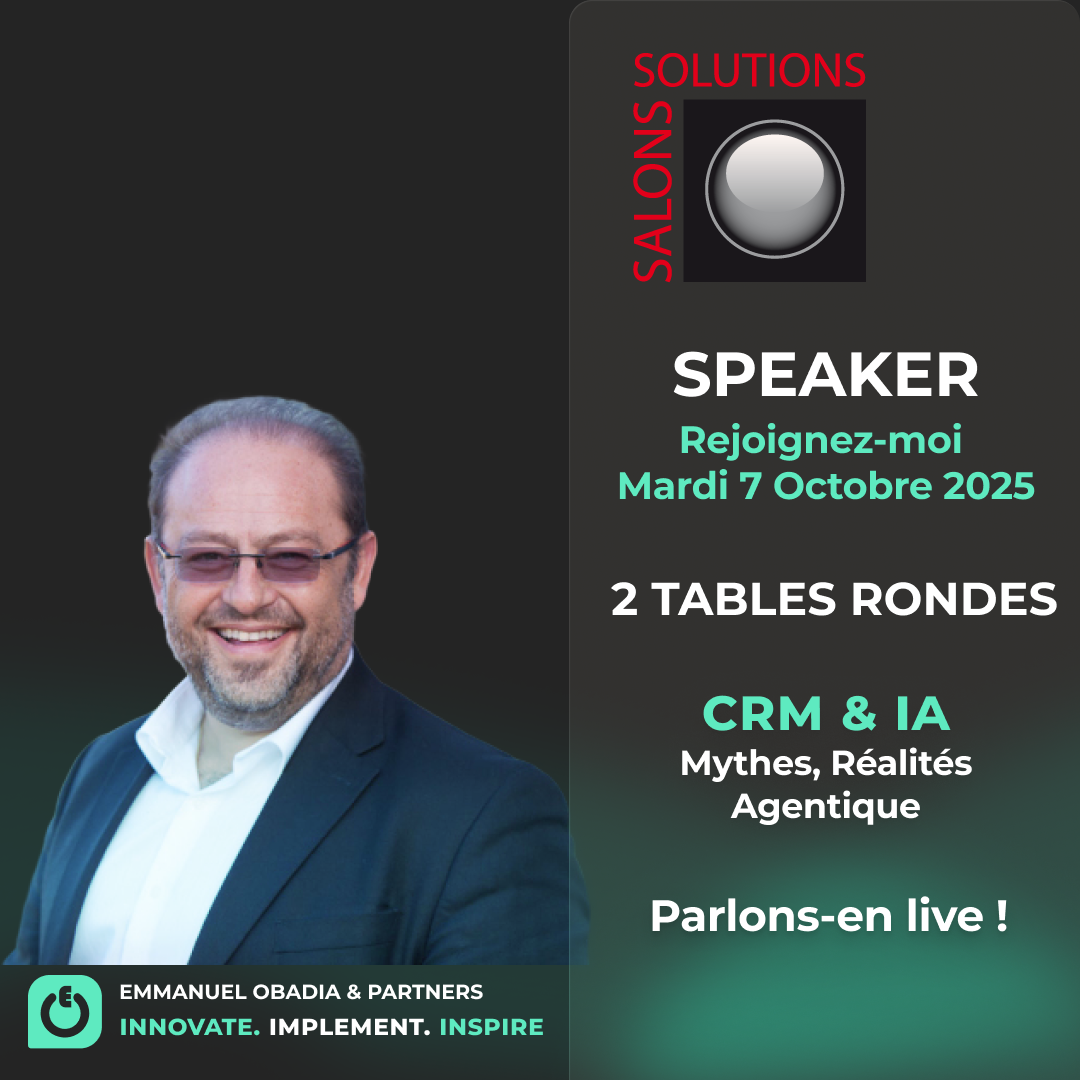
Below are five practical truths I’ll discuss at Salons Solutions (Paris) on Oct 7—and how you can put them to work this quarter.
Your first AI win isn’t AI. It’s data you can trust.
AI doesn’t fix messy data; it magnifies it.
Quick win: Run a 2‑week “data spring‑clean” sprint before any AI pilot. Your models, forecasts, and automations will instantly improve.
Most “AI failures” can be traced back to CRM data quality issues, including duplicates, stale contacts, missing fields, and vague stages. Before you pilot an assistant or a copilot, define a 3‑step mini‑play:

- Deduplicate: one company, one contact, one owner.
- Define required fields: owner, segment, stage definition, and next step.
- Enforce stage criteria: a deal only advances to the next stage when a verifiable event occurs (e.g., BANT-light or MEDDICC milestone).
Recent studies highlight the urgency: around 76% of professionals report that less than half of their CRM data is accurate or complete, and Gartner estimates bad data costs businesses up to $15M annually. A simple baseline metric for SMBs: track the % of records with both an owner and a defined next step.
AI isn’t a big‑company toy. It’s your unfair advantage.

Lean teams benefit most from automation of the repetitive, high‑volume work that clogs days: research, note‑taking, summaries, first‑draft outreach, and routing. Modern CRMs ship with assistants you can turn on without a data‑science team.
Where SMBs win fast
- Prospecting: automatic account research; first‑pass email drafts tailored to your Ideal Customer Profiles (ICPs).
- Service: knowledge‑base answers surfaced in chat or email; auto‑summaries pushed to tickets.
- Marketing: on‑brand first drafts for landing pages and posts; repurposed long content.
Case‑in‑point: Aerotech, a precision manufacturer, adopted HubSpot’s AI assistants and saw win‑rates on new logos rise by 66% while each seller reclaimed over 18 hours per week. The improvement came from consistent discovery, faster research, and automated follow‑ups that no lead slipped through.
What made it work: standardized discovery checklists, a shared prompt library, and manager coaching to reinforce new workflows.
Don’t “implement AI.” Hire a team of task‑specific agents.

Thinking “AI project” paralyzes teams. Think agents instead—small, job‑specific automations.
How to roll out
- Pick one team, one use case, one metric (e.g., reduce time‑to‑first‑response from 8h → 1h).
- Pilot for 2 weeks. Shadow the agent; measure the before/after.
- Standardize prompts & guardrails. Save what works as templates/macros.
- Scale to a second agent only after the first creates visible value.
Guardrails: define Personally Identifiable Information (PII) handling (e.g., names, emails, phone numbers—ensure no sensitive fields go into prompts), tone guidelines, and a clear human‑in‑the‑loop path for exceptions/escalations.
Your starter agent bench
- Service Agent (KPI: First Response Time (FRT)/deflection): answers routine questions from your Knowledge Base (KB); escalates with a clean summary.
Prompt example: “Using our KB, draft a concise reply to this ticket. Include 3 steps, link the exact KB article, and add a 1‑line confirmation question. Summarize context for the agent if escalation is needed.” - Prospecting Agent (KPI: meetings set): enriches new leads, drafts first touch, proposes next best action.
Prompt example: “Research {{company}} against our ICP. In 120 words, draft a first email referencing one trigger and one pain hypothesis. End with a soft CTA for a 20‑min call. Add 3 discovery questions.” - Content Agent (KPI: cycle time from brief → first draft): turns briefs into first drafts; rewrites for channel (blog → LI post → email).
Prompt example: “Turn this 300‑word brief into a 500‑word blog outline with H2/H3s, then produce a LinkedIn teaser (≤120 words) and an email intro (≤60 words). Maintain brand voice: pragmatic, JTBD‑oriented.” - Ops Agent (KPI: pipeline hygiene index): watches pipeline hygiene; flags missing next steps or stage slippage.
Prompt example: “Scan open opportunities closing this month. List records missing owner or next step, and deals stuck >14 days in stage. Output a table with account, stage, days‑stuck, next action suggestion.”
Coach’s tip Job-To-Be-Done (JTBD): Define the agent’s “job to be done.” If the job is “help a rep reach a confident next step,” your evaluation metric changes from “emails sent” to “meetings set” or “deal momentum.”
From efficiency to empathy: designing moments that matter

Yes, assistants save hours. But the strategic return is relationship quality—more time for discovery, context, empathy, and creative problem‑solving. Treat automation as the way to create better human moments, not replace them.
How to measure it: time reallocated → quality of discovery (clear problem framing, documented next step) → CSAT/NPS after human handoff. Track this chain over a month to see whether freed‑up time turns into better conversations and outcomes.
What changes when the busywork drops:
- Sellers spend time with customers, not CRMs—leading to richer conversations and cleaner next steps.
- Service agents focus on the tough cases—with context at hand and a calmer tone.
- Marketers ship more tests, learn faster, and speak the customer’s language.
Design for “moments that matter”:
- Route for expertise: get complex cases to your best humans fast.
- Equip the call: give agents a one‑page dossier (context, last actions, likely intent).
Operationalize it in your CRM: Build a “Moments that matter” view (filters: channel=bot→escalated, priority=high, tier=A) with alerts for stalled handoffs (>2h) and a simple moment_tag field to track outcomes. Review this list weekly alongside a small dashboard for deflection, post‑handoff CSAT, and a few qualitative notes to keep the team focused on relationship quality.
A 30‑Day Plan to Pilot AI in Your CRM
| Week | Focus | Action |
|---|---|---|
| 1 | Data hygiene sprint | Define required fields; delete duplicates; agree stage definitions |
| 2 | Pick one agent | Choose a narrow job (e.g., reply‑assist for support email). Baseline the metric |
| 3 | Run the pilot | Shadow outputs, tighten prompts, set guardrails. Document what “good” looks like |
| 4 | Lock in the win | Put results in a one‑pager; templatize; train the team; decide the next agent |
FAQs I Often Get (and What I Answer)
- “Do we need a data scientist?” No. Start with CRM admin + business owner + one champion per team.
- “Is my data good enough?” Make it “good enough for the use case.” You don’t need perfect data to summarize tickets or draft outreach.
- “What about compliance?” Map where data flows and who can read it. Start with non‑sensitive use cases; involve your DPO early.
Conclusion — Your Augmented Future Starts Small
AI in CRM isn’t about replacing people. It’s about removing the friction that keeps your people from doing their best work: thinking, creating, and building relationships. Start with data you trust, deploy one agent with one metric, and scale what measurably improves customer moments.
Prompt to act: If an agent could take 60% of your team’s repetitive tasks starting next month, which customer‑impact project would you launch first?
👉 If this sparked an idea, DM me—I’d love to hear how you’d apply it. Share in the comments, or message me to continue the conversation.
For the Salons Solutions Audience (Oct 7)
Join me at the round tables where I’ll unpack the five truths in practice—sharing concrete examples and lessons learned. You’ll leave with actionable ideas you can test in your own CRM right away.
👉 One simple way you can engage during the event: Say hello after the round tables, connect with me on LinkedIn, mentioning you attended Salons Solutions, and add your biggest AI question in the event’s LinkedIn thread.

 Emmanuel Obadia & Partners | Transform & Innovate