From High-Growth Startups to Enterprise Giants: The Scaling Lessons No One Teaches You
The Whisper of Chaos
Before becoming a Sr. Advisor, Public Speaker and Executive Coach, I was a founder. Twice. And whether it was raising funding, scaling a product globally, driving a transformation or aligning an international team, I’ve known what it feels like to move fast—and still feel stuck.
I remember one particularly tough moment when I was leading an ERP product to establish a global presence. We had all the pieces in place—great technology, a talented team, and strong corporate backing—but we still couldn’t align our efforts. Growth stagnated, and the sense of being “stuck” was palpable. It was like running in place, doing everything fast, but going nowhere.
Fast forward to now, coaching startup founders and guiding corporate transformation leaders, I picked up Gino Wickman’s Traction again. It hit differently this time. Not as a new tool, but like a field guide to things I had lived. And when I rewatched Ash Maurya’s — check Lean Foundry’s youtube channel – take on Lean—problem-first, data-hungry, learning-driven, and relentlessly focused on finding traction before scale—I realized something else:
We don’t lack frameworks. We lack operating systems for clarity.
Playbooks Are Not Enough
Traction gives structure through the Entrepreneurial Operating System (EOS)—a framework designed to bring vision, discipline, and accountability to leadership teams. Lean Startup gives speed, and JTBD (Jobs-To-Be-Done) helps us understand the deep motivations behind customer behavior. But where Ash Maurya’s Lean Canvas and 10x Model really shine is in their reminder that innovation isn’t about incremental change. It’s about delivering such compelling outcomes that customers feel compelled to switch.
I worked with a SaaS startup that initially focused too heavily on rolling out features instead of defining a clear MVP. Instead of chasing an audience with freemium or beta offerings, we focused on a select group of 10 paying customers, gathering direct feedback that would later drive our product’s scale.
Ash challenges the typical MVP mindset. He argues that MVPs are not about shipping a broken or half-built product, but about delivering a clear, focused solution that creates real progress for a small group of high-value early adopters—redefining MVP from viable to minimum valuableproduct. He warns against using freemium or beta programs at launch, which dilute value perception and prevent real learning. Instead, he urges teams to find 10 real paying customers whose success stories you can deeply understand and scale from.
This aligns with Geoffrey Moore’s Crossing the Chasm theory: even with a few early adopters on board, the real challenge is reaching the early majority. There’s a dangerous gap—a chasm—between those willing to try anything new and those who want proven outcomes. If you don’t craft your offer and delivery model for this leap, your growth will stall.
The 10x mindset also forces you to stop thinking in incrementalism. Marginal improvements don’t create traction. Customers switch only when the difference is meaningful and progress is obvious. That’s where JTBD adds depth—by helping you map the triggers, anxieties, and desired outcomes of real people trying to make progress in their lives.
In practice, what founders, business unit leaders, and transformation teams need is more than a checklist or a framework.They need to:
Align fast around real problems (not just ideas)
Build execution rhythm, not just pitch decks
Stay customer-obsessed as they scale
Deliver 10x improvements, not 10%
What’s different today is how AI and Generative AI are radically boosting the dynamic behind each of these imperatives. AI has moved beyond hype to become a quiet multiplier—an operating layer that helps teams move faster, with more precision and less guesswork.
AI and Generative AI can help analyze feedback, reviews, and sentiment to highlight where customers are really struggling. It powers project tools that reinforce team rhythms and accountability. It segments behavior at scale, surfaces unmet needs, and reveals insights that drive customer obsession. And with Generative AI, teams can explore bold ideas, rapidly prototype, test messaging, and validate directions—before investing in full-scale rollout.
A SaaS company I supported recently wanted to accelerate growth in a mature market. While their teams had strong relationships, they lacked a shared understanding of the real reasons clients renewed—or didn’t. We used a JTBD approach to uncover hidden motivations: progress meant helping clients shine internally or anticipate PR crises, not just using features.
To bring those insights to life, we also introduced Generative AI into the sales workflow. It helped reps prepare smarter for account planning sessions by distilling customer interviews into talk tracks aligned with each client’s key jobs. This made their outreach more relevant and strategic.
That mindset shift—from selling capabilities to enabling outcomes—reframed how the teams engaged customers. And it opened up new doors for cross-sell and upsell conversations that had previously gone unnoticed.
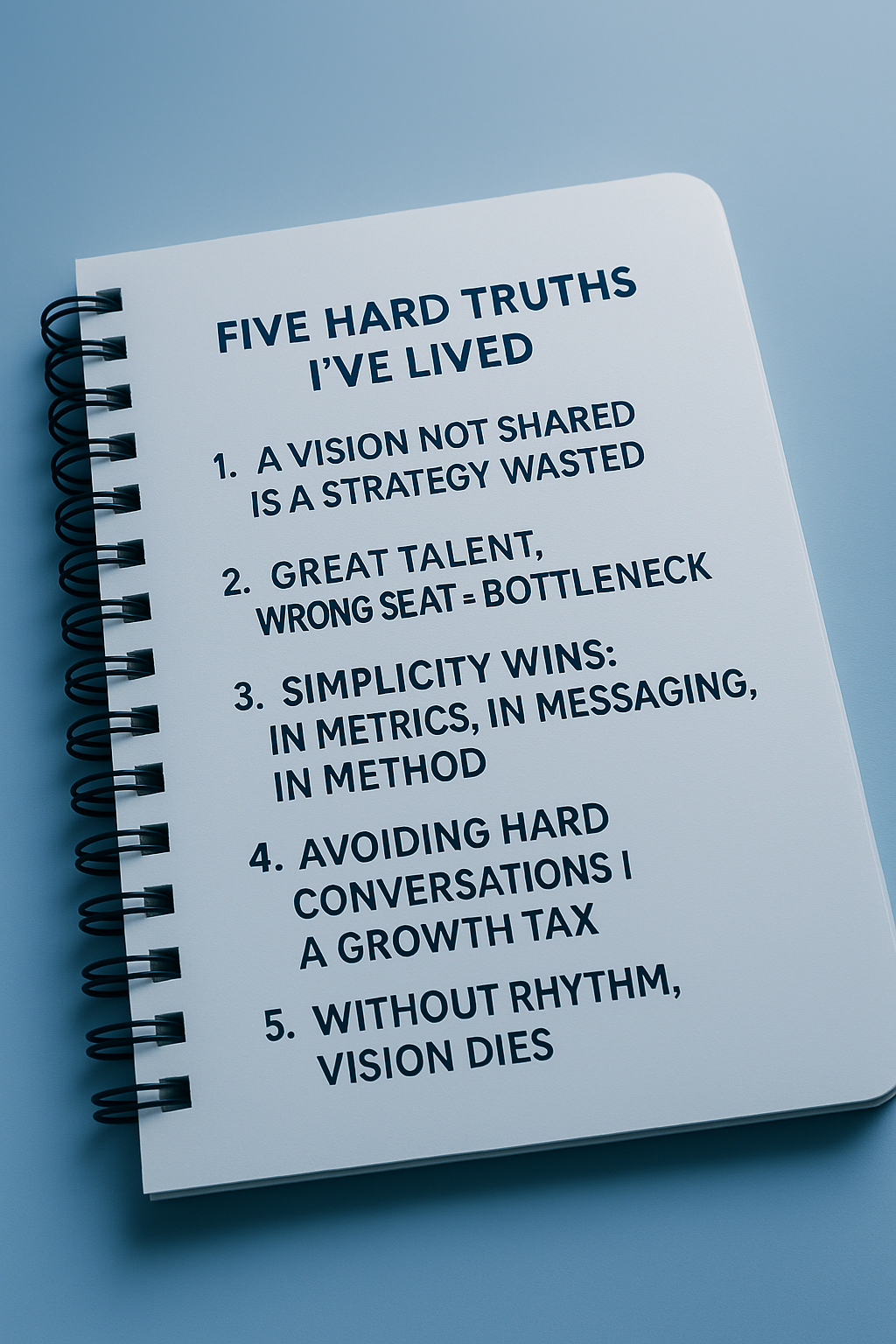
1. A Vision Not Shared Is a Strategy Wasted Wickman’s V/TO (Vision/Traction Organizer) encourages leadership teams to answer 8 fundamental questions: from core values to 10-year targets. Ash’s Lean Canvas does something similar but quicker—mapping key hypotheses about customers, problems, and solutions. Moesta’s JTBD framework adds the psychological layer—defining the emotional and functional “why” behind customer behavior.
I’ve seen what happens when these are skipped. In a transformation project I was close to, we built a beautiful roadmap—but each team interpreted the mission differently. Without a shared vision, even the smartest teams can pull in conflicting directions.
💡 Key takeaway: Start by aligning your leadership around a shared vision. Use tools like V/TO to avoid misdirection from the outset.
2. Great Talent, Wrong Seat = Bottleneck The Entrepreneurial Operating System (EOS) reminds us that values + role fit matter. Ash warns not to hire before validation. I’ve seen brilliant people hired too early, or held too long—crippling momentum. One startup I advised had a rockstar head of growth, but his aggressive style clashed with the brand’s consultative tone. The fix wasn’t coaching—it was role realignment.
💡 Key takeaway: Don’t just hire talent—align talent to the right roles early to keep the momentum.
3. Simplicity Wins: In Metrics, In Messaging, In Method Wickman’s Scorecard simplifies execution into 5–15 core numbers. Ash promotes “One Metric That Matters.” Moesta insists that customer progress must be measurable. And in execution, nothing beats OKRs for translating vision into action.
Just like a car’s dashboard displays the most critical data to ensure smooth navigation, OKRs help guide teams toward ambitious, clear outcomes. KPIs, like the constant updates on a car’s speedometer, show progress but don’t dictate direction. This balance of simplicity in both the metrics and messaging ensures that teams stay aligned with their core objectives without being overwhelmed by unnecessary complexity.
I’ve helped both scaleups and large organizations replace bloated KPI dashboards with one sharp OKR set tied to customer outcomes—and the shift in alignment and morale is immediate. When your metrics reflect real progress (not vanity), and are powered by AI insights, they become a lever. The most effective teams I’ve seen and led combine a top-down logic—through clear Objectives and Key Results (OKRs)—with a bottom-up dynamic, where field teams contribute initiatives, observations, and customer insights that shape those OKRs. It’s this dual flow that strengthens governance and boosts employee engagement—turning OKRs into a shared language of progress, not just another top-down planning tool.
💡 Key takeaway: Simplify your metrics to focus on outcomes and drive progress. Integrate AI to continuously measure and course-correct.
4. Avoiding Hard Conversations Is a Growth Tax EOS teaches IDS (Identify, Discuss, Solve). Ash insists on fast feedback loops. JTBD helps name the real frictions customers feel—often things your team avoids talking about.
In one post-merger integration I supported at a large tech firm, the sales and product teams weren’t speaking openly. Features were shipped without client context. We used the IDS method to surface issues weekly, and within a few months, alignment (and revenue) were back on track.
💡 Key takeaway: Use frameworks like IDS to create space for hard conversations and stay aligned as a team.
5. Without Rhythm, Vision Dies EOS Rocks and Level 10s, Lean Build-Measure-Learn cycles, Moesta’s JTBD loops, and Ash’s 10x ambition—all converge on one thing: cadence.
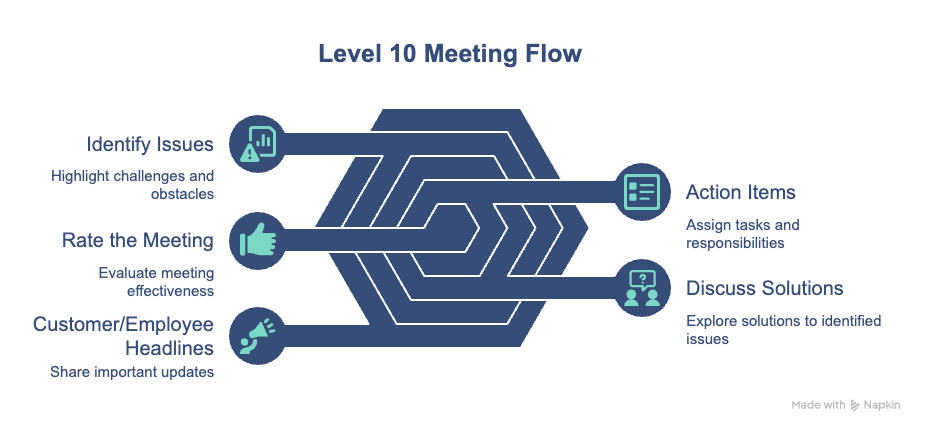
Level 10 meetings, a concept from the Entrepreneurial Operating System (EOS), are weekly leadership check-ins designed to drive focus, accountability, and problem-solving. In these meetings, the leadership team reviews key metrics (Scorecard), evaluates progress on top priorities (Rocks), shares customer and employee headlines, and solves the most pressing issues of the week (using the IDS method). It’s this regular, rhythmic cadence of meetings and reviews that ensures alignment, execution, and continuous improvement.
As a Chief Product Officer (CPO), I built quarterly OKR rituals not just to track progress, but to generate momentum and drive habitual execution. Today, Generative AI does more than just speed things up—it enhances the entire rhythm of work. It surfaces insights, highlights struggles, and enables teams to make informed decisions faster. But at its core, the most important shift comes from within: teams become more accountable, communication becomes clearer, and leadership adapts to new ways of working. When execution becomes a habit, and leaders learn to use AI insights in real time, that’s when transformation happens.
💡 Key takeaway: Use cadence to drive sustained progress—combine AI-driven insights with structured execution frameworks.
WHERE ‘IMPACT’ METHODOLOGY COMES IN
I createdIMPACT to blend these strengths into a modern methodology that harnesses AI. It’s structured in six steps:
Identify – Use JTBD and Generative AI to identify real unmet customer needs, going beyond surface-level assumptions to dig deeper into what really drives progress.
Map – Take those insights and turn them into a clear, aligned strategy using tools like IDEO’s Design Thinking and the Value Proposition Canvas. AI helps refine personas and predict customer behavior, making mapping even more accurate.
Plan – Translate strategy into actionable OKRs and Agile roadmaps that focus on what truly matters. Use AI-enhanced data to prioritize key objectives and minimize distractions.
Act – Execute cross-functionally by empowering teams to own their roles, using adaptive storytelling to make the mission come alive. AI assists in real-time adjustments and learning as teams progress.
Calibrate – Measure, learn, and iterate based on AI-powered analytics that highlight blind spots, uncover emerging jobs-to-be-done, and drive the next set of decisions.
Transform – Anchor change across the organization through leadership coaching, scaling successful initiatives, and embedding a culture of continuous improvement.
It’s not just a method. It’s the operating system I wish I had when scaling my own business—and the one I now use with SaaS CEOs and product teams to turn vision into results.
By integrating the IMPACT methodology with the insights from Traction, Ash Maurya’s Lean Startup principles, and Generative AI, I’ve created a framework that aligns strategy, execution, and customer focus. From Identifying real customer needs using JTBD, to Mapping a clear strategy with tools like Lean Canvas and V/TO, each phase builds upon a foundation of clarity, precision, and agility. Planning through OKRs ensures teams focus on outcomes that matter, while Acting with discipline, rhythm, and the power of AI accelerates results. Regular Calibration via real-time feedback allows for quick course correction, while leadership-driven Transformation ensures sustainable change. Together, these steps form an operating system that helps businesses scale with purpose, accountability, and speed—empowering leaders to confidently navigate today’s fast-paced, AI-driven world.
FINAL THOUGHT – CHOOSE YOUR SYSTEM CONSCIOUSLY
We all have systems—some deliberate, others default. Whether you’re scaling a startup, transforming a business unit, or rebuilding your GTM playbook—don’t leave your operating system to chance.
Traction gave me language. Lean gave me discipline. JTBD gave me customer truth. The 10x Model reframed ambition. OKRs gave me focus. And Generative AI now gives us foresight.
IMPACT ties it all together.
IMPACT is a system for teams that want to scale with purpose—leveraging AI insights and agile execution.
So, how well-aligned are your teams around vision and outcomes? Are you using a system that amplifies customer truth, execution rhythm, and innovation?
Let’s discuss how IMPACT, combined with AI-driven insights, can transform your business strategy and accelerate your growth. Schedule a 30-minute session to explore your path forward.
With over 30 years of experience in software, I’ve had the opportunity to work as an entrepreneur and international executive for some of the biggest names in tech, including Lotus, IBM, Peoplesoft, Sun Microsystems, Sage, Salesforce, and Oracle. As a former EMEA Vice President of Marketing and Global Chief Product Officer, I gained invaluable insights into the rapidly changing tech industry.
Today, I’m an Optimist Sr. Advisor, Executive Coach & Mentor, and public speaker. I’m thrilled to help teams of any size thrive in complexity, speed, and change, and to inspire transformation and innovation for impact. I’m passionate about empowering individuals and organizations to make a lasting mark on the world. If you want to learn more about my journey, please check out my bio and About for additional details
My motto: “Authentic leadership: unlocking the potential to achieve the impossible.”
View all posts by Emmanuel Obadia







 Emmanuel Obadia & Partners | Transform & Innovate