

- The Genesis of a Company
- Key Strategies for Scaling
- Identifying Your Minimum Viable Segment (MVS)
- The Role of Pricing and Ecosystem Engagement
- Fostering Continuous Innovation and Customer Feedback
- Conclusion
Introduction
In the exhilarating journey from a spark of innovation to the establishment of a thriving company, entrepreneurs and innovators often face a formidable chasm: transitioning from a compelling product idea to a scalable business model. This leap, daunting yet essential, marks the metamorphosis of a startup into a sustainable enterprise. Drawing upon my own venture into creating a software company, I’ve navigated this very transition, encountering the intricate dance between innovation and scalability. I’ve also experienced it firsthand when introducing a new offer as a Chief Product Officer at Sage, in a market dominated by 800-pound gorilla leaders such as SAP, Oracle, or Microsoft. Today, we delve into strategies that bridge this gap, ensuring enduring growth for businesses. Whether leading a nascent startup, steering innovation in a corporation, or guiding an SMB, these insights aim to light your path through this pivotal business development phase.
‘The chasm between ‘charismatic’ early adopters and the ‘pragmatic’ early majority is where high-tech fortunes are won or lost.’
Geoffrey Moore, best seller author of Crossing the Chasm

The Genesis of a Company
The inception of every transformative company sparks from an idea—a moment of clarity where the solution to a problem seems almost too evident. Reflecting on my own entrepreneurial journey, it was this initial product idea that set the stage. Yet, as many founders learn, the genesis of a company involves more than just product innovation; it requires a deep understanding of market needs and a vision for scalability. This realization came as I navigated the “Product Company Gap,” a crucial transition that many overlook.
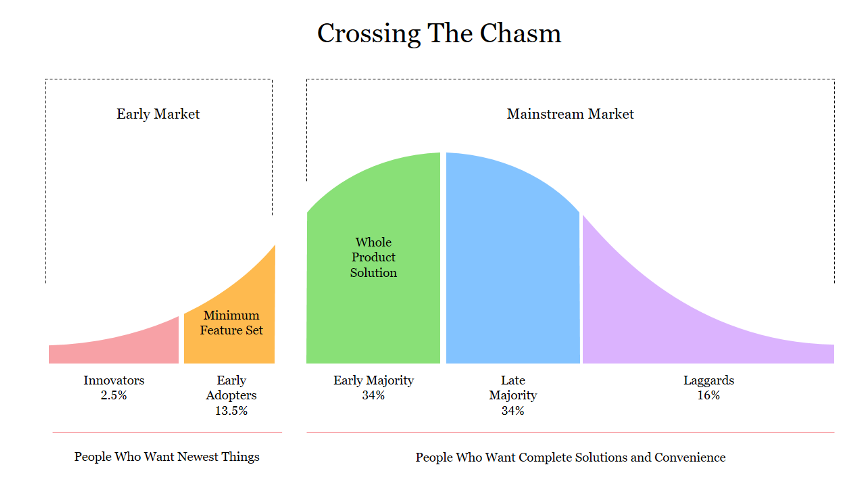
This gap symbolizes the chasm between possessing a product that meets market fit and evolving into a scalable, growth-oriented company. My venture, while founded on a groundbreaking product, faced the quintessential challenge of scaling. The journey from product ideation to establishing a company ready for market dynamics and evolving consumer needs was fraught with pivotal decisions. Ultimately, the path to scalability led to an acquisition by a larger entity—a testament to the notion that scaling often requires strategic alliances and an openness to evolving business models.
Key Strategies for Scaling

The leap from a minimum viable product (MVP) to a sustainable, scalable company requires more than just a market-fit product; it demands a well-orchestrated strategy that encompasses design, market engagement, and adaptability. Drawing upon my own entrepreneurial journey, where I founded a software company that eventually became profitable enough to catch the eye of a larger acquirer, I’ve come to recognize the multifaceted nature of scaling a business. The lessons learned from that experience have informed the following strategies, crucial for any company aiming to not just survive but thrive in today’s dynamic market landscape.
- Designing for Scale
From day one, envision your product not as an endpoint but as a catalyst for growth. This means considering scalability in every design decision—how will your product adapt as your customer base grows? Can your infrastructure handle a surge in demand? In the early stages of my venture, we iterated relentlessly, ensuring our software could scale seamlessly with increasing user loads, a factor that significantly contributed to its attractiveness to the acquiring company. - Beyond MVP: Cultivating Sustainable Growth
An MVP is merely the first step in a marathon. Sustainable growth hinges on your ability to expand and adapt your product to meet evolving market needs. Reflecting on my journey, post-MVP development was pivotal; we focused on adding features that our customers were clamoring for, which not only solidified our market fit but also enhanced our value proposition to potential acquirers. - Engagement and Costs: The Sales and Marketing Pivot
As your product matures, the inevitable shift from development to sales and marketing can be a jarring pivot for many founders. My journey mirrored this transition, evolving from a software developer to a marketer. This shift wasn’t just a change in focus; it was a defining moment that ignited my passion for marketing, a skill set that would later become my forte in larger corporations. This evolution underscores a vital truth in scaling: having a stellar product isn’t enough; the market must be aware of and understand its value.
Case Studies and Anecdotes: Lessons from the Field
- Slack’s Strategic Market Positioning: The story of Slack, evolving from a gaming company’s internal tool to a premier enterprise messaging platform, exemplifies the essence of market fit and strategic pivoting. In a saturated market, Slack carved a niche through its seamless integration, user-friendly design, and scalability. This case illustrates the critical role of understanding and adapting to market needs, propelling Slack towards rapid growth and a triumphant IPO.
- Airbnb’s Global Expansion and Trust-building Strategies: Airbnb’s ascent from offering short-term living room rentals to becoming a global accommodation marketplace highlights the power of trust and community engagement. Airbnb’s focus on user experience, a robust review system, and social proof enabled it to scale across borders while maintaining trust and quality. This narrative accentuates the importance of fostering customer trust and a sense of community as foundational elements of scaling a platform-based enterprise.
Reflecting on these insights alongside my own entrepreneurial voyage, it’s evident that scaling a business is a complex, multifaceted journey. It demands a blend of strategic foresight, market acumen, and the flexibility to navigate shifting landscapes. As we delve into specific scaling strategies, it’s crucial to remember that while each company’s journey is distinct, the principles of thoughtful expansion and engaging customer interaction stand as the bedrock of lasting success.
Identifying Your Minimum Viable Segment (MVS)
“Securing a beachhead market is the most crucial strategy in crossing the chasm. It’s about focusing your efforts on a niche where you can dominate, serving as a base for broader market expansion.”
– Geoffrey Moore
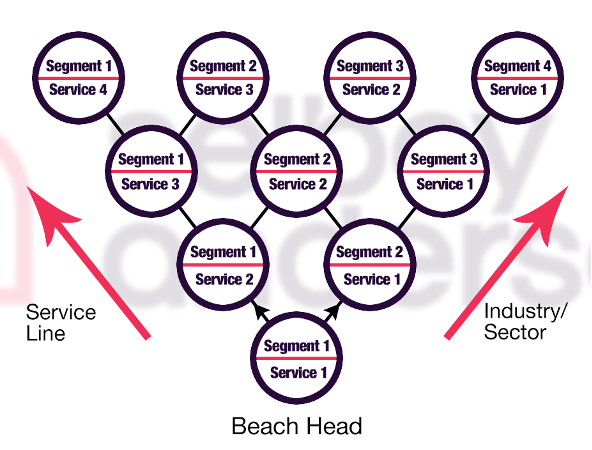
Before delving into the intricacies of pricing and ecosystem engagement, there lies a fundamental step often overlooked yet critical for sustainable scaling: pinpointing your Minimum Viable Segment (MVS) also referred to by Geoffrey Moore in his famous work, “Crossing the Chasm”, which was my bedside book at the time of my early marketing steps: your beachhead market. This concept, derived from my firsthand experience and observations in the tech industry, emphasizes the importance of focusing on a narrowly defined group of customers who most urgently need your product and are willing to adopt it early on.
Sometimes I get asked: how large should this segment be? There’s no one-size-fits-all answer, but rather, it should include enough customers to prove you can dominate your first niche market. For a startup, I’d suggest aiming for a few hundred.
The Essence of MVS Scaling a business goes beyond the appeal of a product that aims to be universally captivating; it necessitates an in-depth exploration to pinpoint exactly who needs your solution most urgently at this moment. Reflecting on the early days of my software company, we realized that our broad aspirations needed sharper focus. We identified a specific market segment showing a clear readiness and need for our innovation. This deliberate focus was instrumental—it allowed us to refine our development and marketing strategies to meet the particular requirements of this group, ensuring our solution not only filled a market void but also surpassed any alternatives available.
This strategy wasn’t confined to my venture’s beginnings; it was equally pivotal during my time at Lotus Development in EMEA. There, I chose to engage business leaders driving major transformations—particularly those involved in Business Process Reengineering—rather than following the conventional path of appealing directly to CIOs. By zeroing in on their core Jobs-To-Be-Done (JTBD), we positioned Lotus Notes as a formidable contender against Microsoft Exchange. This approach not only laid the groundwork for a successful Go-To-Market (GTM) strategy but also helped foster a vibrant partner ecosystem. As a result, we enjoyed market shares exceeding 50%, significantly outperforming Microsoft’s 20% at the time
MVS as a Catalyst for Growth
Focusing on an MVS does more than just provide initial traction; it serves as a litmus test for your product’s broader market viability. For instance, Airbnb initially targeted travelers looking for affordable, short-term lodging options during conferences when hotels were overbooked. This specific focus allowed them to perfect their value proposition, build a loyal user base, and eventually expand to the global powerhouse they are today.
Learning from the Market
Identifying and serving your MVS also sets the stage for invaluable learning opportunities. It offers direct insights into customer behaviors, preferences, and feedback, which are crucial for iterative product development and innovation. During my tenure at Sage, focusing on a segment of small to medium-sized businesses in a few countries that were underserved by existing solutions allowed us to not only capture the market efficiently but also gather rich feedback that informed our future expansions and enhancements to reach the enterprise market globally.
Integrating MVS into Your Scaling Strategy
Incorporating the concept of MVS into your scaling strategy requires a deep understanding of your customer base, competitive landscape, and the unique value your product offers. It’s about asking the right questions: Which segment of my target market is most ready for my solution? How can I address their needs in a way that’s compelling and differentiated? Answering these questions can focus your efforts, conserve resources, and significantly increase your chances of early and sustained success.
As we explore the dynamics of scaling a business, the notion of MVS emerges as a cornerstone of strategic planning. It underscores the significance of targeted focus in the initial stages of growth, ensuring that your journey from a promising startup to a scalable enterprise is grounded in market realities and customer needs. By identifying and serving your Minimum Viable Segment, you lay a solid foundation for continuous innovation, customer feedback integration, and, ultimately, scalable growth.
In the following section, we’ll delve into The Role of Pricing and Ecosystem Engagement as pivotal elements in the scaling equation.
The Role of Pricing and Ecosystem Engagement

Understanding the interplay between pricing strategies and ecosystem engagement is pivotal in navigating the waters of business scalability. This nuanced dance between making your product accessible and ensuring its perceived value cannot be overstated. Reflecting on my own journey, particularly as a Chief Product Officer, where strategic decisions around pricing played a critical role in our acquisition, I’ve learned that the right pricing model can be a growth catalyst, opening doors to new markets and opportunities.
Pricing as a Lever for Growth Pricing is not just a matter of numbers; it’s a strategic tool that communicates value, attracts the right customer segments, and sets the stage for scalability. For instance, consider the freemium model adopted by Spotify. By offering a base service for free and charging for premium features, Spotify not only broadened its user base but also created a clear pathway for upgrading users to its paid service, exemplifying how dynamic pricing models can fuel growth. For a deeper dive into optimizing SaaS business models, refer to my previous post on how to optimize a SaaS business and specifically into the definition of what a value metric is.
Ecosystem Engagement: Beyond the Product In the realm of scalability, your product does not exist in isolation. It’s part of a larger ecosystem—a network of partnerships, platforms, and community engagements that can significantly amplify your reach and impact. Drawing from the Airbnb example, their success was not solely due to their innovative platform but also their ability to foster a sense of belonging among its users and hosts. This community-centric approach, coupled with strategic partnerships, propelled Airbnb into the global marketplace.
Similarly, in my ERP software venture at Sage, embracing ecosystem dynamics—partnering with complementary service providers and integrating with existing platforms—was instrumental in expanding our market presence even in Germany against SAP. These collaborations not only enhanced our product’s value but also solidified our foothold in the market, facilitating a smoother transition during our acquisition.
Building Strategic Partnerships The creation and nurturing of strategic partnerships stand as a testament to the power of collaboration in scaling efforts. For example, Slack’s integration with a plethora of productivity tools didn’t just enhance its platform’s utility—it embedded Slack within the operational fabric of countless organizations, creating indispensable value. This strategy of building alliances within the ecosystem can significantly elevate a company’s position in the market and its potential for scalability.
As we navigate the complexities of scaling a business, the importance of a well-considered pricing strategy and active engagement within your ecosystem cannot be overstated. These elements are crucial for not only attracting and retaining customers but also for embedding your product within a larger network of value that extends beyond its immediate functionality. As we continue to explore the facets of business growth, remember: scalability is as much about external alignments and partnerships as it is about the product itself.
In the next segment, we will explore how continuous innovation and customer feedback loop into the scaling equation, ensuring that your business not only reaches new heights but also maintains its relevance and competitiveness in an ever-evolving market.
Fostering Continuous Innovation and Customer Feedback
“The only way to win is to learn faster than anyone else.”
Eric Ries – Author of the Lean Startup

In the dynamic arena of business growth, the dual forces of relentless innovation and the integration of customer feedback into your development process stand as pillars of scalability. This cyclical process of feedback and refinement guarantees that your product not only aligns with current market demands but also anticipates and shapes future trends, securing a competitive edge.
The Innovation Imperative
Innovation is a perpetual voyage, not a destination. My entrepreneurial journey illuminated that a product’s initial success is no assurance of its enduring relevance. The landscape is in constant flux—technologies evolve, consumer preferences shift, and new challengers arise. Netflix’s metamorphosis from a DVD rental service to a streaming behemoth and, ultimately, a content powerhouse exemplifies the critical need for strategic agility and foresight in navigating market transformations.
Integrating Customer Feedback
Progress is propelled by innovation, yet anchored in reality by customer feedback. Successful enterprises engage in continuous dialogue with their clientele, decoding their needs, grievances, and aspirations. Such conversations are a goldmine of insights, steering product evolution in a way that deeply connects with users. My tenure as CPO at Sage and subsequent roles at Sun, Oracle, and Salesforce, were formative in learning this lesson, underscoring the indispensable value of listening to and acting on customer feedback.
Tesla’s revolution of the automotive sector illustrates the transformative power of customer responsiveness. By heeding feedback shared through social media and direct channels, Tesla has introduced features and updates that directly cater to user needs, often deploying them in real-time via software updates. One of the major disruptions of Tesla’s business model lies in its direct relationship with end customers, without any channel involved outside of the digital one. This approach not only elevates customer satisfaction but cultivates a fervent community of brand advocates.
Building a Feedback-Driven Culture
Fostering an environment that prizes and acts upon customer insights is crucial. This involves setting up robust feedback mechanisms—ranging from surveys and user testing to social media interactions and direct customer support. More importantly, it’s about nurturing a team mindset that views feedback as an invaluable opportunity for improvement, not criticism.
During my stint as CPO at Sage, adopting a feedback-centric methodology enabled swift product iterations, responding adeptly to user requirements especially going global. This agility was instrumental in our international expansion, reaching over 50 countries from fewer than 10 at the outset, and in rallying a vibrant community of partners to extend our product’s value through add-ons and services globally.
The Strategic Advantage of Customer-Centric Innovation
Marrying continuous innovation with customer feedback bestows a dual benefit: It keeps your product at the forefront of your industry while deepening customer bonds. This fusion of innovation and customer satisfaction drives sustainable growth, catalyzing both market reach and brand allegiance.
As we wrap up this exploration of scaling strategies, it’s pivotal to acknowledge that scaling a business is an iterative, not linear, endeavor. It demands an equilibrium between internal innovation and external ecosystem and customer engagement. Within this dynamic interplay lies the formula for evolving a promising startup into a scalable, lasting enterprise.
Conclusion
In summary, scaling a business intertwines strategic foresight with a steadfast dedication to innovation and customer connection. Through our journey across these strategies, one theme emerges unequivocally: scalability transcends merely meeting today’s market needs—it’s about preemptively crafting tomorrow’s solutions. Whether you’re nurturing a fledgling startup or driving innovation in a large organization, the principles of strategic expansion, ceaseless innovation, and customer-centricity illuminate the path to enduring growth and success.
As we navigate the complexities of scaling a business, it’s clear that the journey is as unique as the visionary behind each venture. Whether you’re in the throes of navigating your startup’s growth or you’re spearheading innovation within a larger organization, the path to scalability is fraught with challenges and opportunities for learning. If you find yourself seeking guidance or simply wish to share your own experiences, I invite you to reach out. Let’s explore how we can turn your scaling hurdles into stepping stones for success. Together, we can craft a strategy that not only meets today’s needs but also anticipates the demands of tomorrow. Connect with me for personalized coaching and mentoring tailored to your unique journey.

 Emmanuel Obadia & Partners | Transform & Innovate